
Veikkaus Calls For Earlier Implementation of Slot Machine Identification

Finland’s gambling monopoly Veikkaus is calling for the implementation of mandatory player identification for slot machines across the country to be pushed earlier than originally planned.

The company’s has been looking to up its social responsibility policies after facing massive public backlash in recent years for not doing enough to protect customers.

RELATED: Finnish Gambling Monopoly to Establish Ethics Council Following Backlash

Under a newly proposed version of the Finnish Lotteries Act, ID checks for slot machines at retail outlets around Finland will become mandatory from 2023. However, Veikkaus recently urged the government to amend the Act and implement the compulsory checks from the beginnings of 2021.

The state-owned company, which is the only organization authorized to provide gambling services in Finland, said last month that it would introduce identity checks at its Feel Vegas and Pelaamo arcades from January next year as part of a wider effort to prevent minors from gambling.

Commenting on their call for earlier implementation of mandatory checks, Veikkaus Senior Vice President for Channels and Sales Jari Heino said that they want to build a gaming environment that will make it possible to look after gamblers experiencing trouble to control their gambling habit and that the compulsory identification will offer them many new opportunities in this respect.

Maximum Loss Limit on Slot Machines

Veikkaus also plans to urge the government to expand the current maximum loss limit for certain online games across slot machines at physical gambling facilities. Mr. Heino said that the loss cap should be implemented by June 2021.

Under current law, the maximum loss limit for online casino games, bingo, and instant win games is set at €1,000 per day and at €2,000 per month. However, these caps were lowered in April by Finland’s Ministry of the Interior to €500 for both daily and monthly losses to help prevent players from gambling excessively during the Covid-19 crisis. The temporary limits will remain in place until September.

RELATED: Finland Online Casino Guide

Other measures announced by Veikkaus as part of its efforts to strengthen its responsible gambling policies include significantly reducing the number of its slot machines around the country. The company originally planned to remove roughly 3,500 of its gaming machines by the end of the year and another 4,500 over the next five years.

However, it said later that it would put offline 8,000 slot machines by the end of 2020. This means that it will ring in 2021 with about 10,500 gambling devices.

The gambling monopoly was heavily hit by the Covid-19 pandemic and the ensuing closure of physical gambling facilities and the halt of almost all sports. It recorded a 28% decline in revenue during the first half of the year to €607.2 million. Profit was down more than a third to €332.7 million.

Veikkaus warned that it will likely fail to meet its projected €1 billion full-year profit due to the much tougher conditions it is forced to operate under.

Follow us on Facebook and Twitter to stay up to date on the day’s top casino news stories

The post Veikkaus Calls For Earlier Implementation of Slot Machine Identification appeared first on Casino News Daily.


Why food price trends in Macau are so critical now

Thanks to a wise Macanese court, a patently ridiculous $12 billion litigation against Las Vegas Sands has been postponed for another year. That may sound like a real relief, but given that the chances LVS would ever be forced to pay such a ludicrous sum are essentially zero anyway, the news is really nothing more than a yawn. This is especially so in the current environment where Macau’s economy has contracted by an unfathomable 61% last quarter, numbers akin to an Independence Day-style alien invasion.
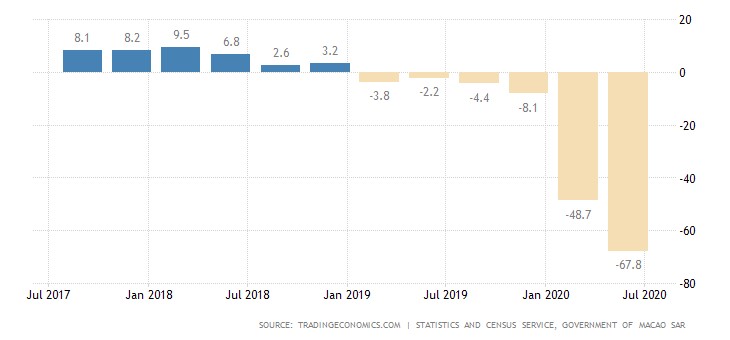
It’s not even that these numbers are entirely COVID-19 related either. Macau’s economy, at least as measured by GDP, has been contracting for 6 straight quarters now. COVID-19 appeared to catch it in the middle of an already year-long downturn.

Even if LVS loses eventually, any sum actually rewarded will be insignificant, and that’s assuming that the current monetary system even survives another year. There are signs out of Macau itself that it may not. Why is Macau relevant to this question at all? Because Macau’s economy is a convenient microcosm of what happens when you are almost entirely dependent on a single industry or export. For Macau it’s gambling. For the United States, it’s dollars, the main and most important American export to the world. Yes, America is also a banana republic in that sense.

Yes, Macau may have a very sophisticated, luxurious, top-tier banana that the world’s super rich just love to snack on, but a banana republic is still what it is.

What is happening in Macau on a macro scale is an extreme case of what is happening across the world. That’s why Macau’s direction will signal where the world is headed more broadly in terms of economic pain. Demand for everything is falling in Macau as the economic engine has stopped, making it look like prices are falling. They are, nominally, just not in terms of percentage of real incomes spent. Except prices are not falling even nominally for one thing in particular: Food.

No matter how poor you are, you still have to eat basically the same amount that you ate the day before, regardless of economic conditions. If aggregate demand for food is falling in real terms, that means the human population is falling. There is no such thing as falling aggregate demand for food so long as the human population on earth is stable or growing. Falling energy demand, sure. People can stop driving, stop traveling, stop moving around, stop using electricity and survive. They cannot stop eating food and survive.

GGRAsia reports on Macau’s massive retail sales decline, and this key paragraph is buried at the end of the article:

The only retail category that showed growth in value of sales – in either the second quarter or the half year – was the supermarket trade. It registered a 13.7 percent second-quarter gain year-on-year, to MOP1.28 billion. The aggregate first-half gain was 14.3 percent, to MOP2.74 billion.

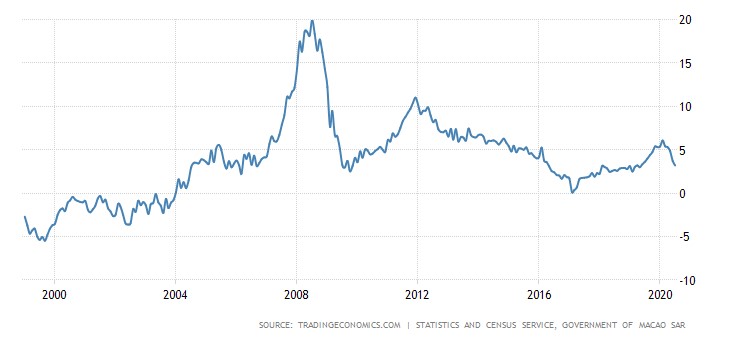
This looks hard to square with food inflation statistics out of Macau now, which show food prices on the surface rising by only 3.2% last quarter. However, in the context a 61% decline in GDP, rising food prices should be a very scary thing. Think of it in terms of percentage of Macanese incomes spent on food this year versus last year. This is why I do not believe that the current bump in online gambling revenues in Europe for example, will be sustainable long term. A higher and higher percentage of incomes will be used up on food bills, leaving less for gaming.

Macau will be a good bellwether here because it historically has been very sensitive to food prices. Here is the long term chart of food inflation there.

You can see how extreme it can get during the final months of a credit cycle boom as we had in 2007/2008, during which the territory did not even see a nominal year over year decline in GDP at all. The worst it got was Q2 2009 when GDP fell just over 10%. The decline now is many times worse. Under the current circumstances of collapsing incomes, if we see food inflation numbers rise even close to what we saw in 2008, we could start seeing food riots in Macau.

I am also getting word from some of my newsletter subscribers in Hong Kong that the average price of a bag of rice there is now 10% higher than it was in February. So it’s not just Macau.

Now it seems the mainstream megabanks are picking up on this. Bank of America currency strategist Athansios Vamvakidis is sounding the alarm on this exact issue, and he isn’t pulling punches. Says Vamvakidis in a note to investors, “In theory, at some point, loose macro policies, in both a good and a bad state of the global economy, will likely lead to inflation.”

What he means by both a good and bad state of the global economy is that food prices can rise even during recessions, for the very reasons I explained above, namely that aggregate food demand cannot fall in any environment assuming stable or growing population. He continues:

The longer it takes [for inflation to show up] the more addicted markets become to macro policy support making the eventual adjustment harder. Even if central banks are willing to overshoot their inflation target, non-linearities may make their task challenging, while in any case markets may start pricing rate hikes and the so-called central bank policy put could weaken. Only low inflation has allowed the I-am-so-bearish-I-am-bullish market in recent years. If and when at some point we do get inflation, this equilibrium will likely break.

So if you want to know if and when the system is about to buckle, watch food prices in Macau. If they start heading down again, we may have another few years of limping along. Here’s to hoping.

The post Why food price trends in Macau are so critical now appeared first on CalvinAyre.com.

UK gaming council gives itself a pat on the back for gambling ad ban

In August of last year, the U.K., in one of its many attempts at micromanaging the gambling industry, implemented a policy that prohibits ads by gambling operators during sports telecasts. The “whistle to whistle” ban states that, from five minutes before a televised sports event to five minutes after, no gambling ads can be seen, unless the match takes place after 9 PM. The U.K. Betting and Gaming Council (BGC) took a look recently at the effectiveness of the ban and found that it is working well, allowing the council to give itself a pat on the back for its efforts. 

Analysis firm Enders Analysis conducted research on the performance of the ban, determining that the number of gambling ads seen had dropped by 97% since the implementation of the policy. It also found that the number of gaming-related ads viewed by youth had declined by 70% across the entire span of live sport telecasts. This led BGC CEO Michael Dugher to assert, “The BGC was set up to improve standards in our industry. The success of the whistle to whistle ban is a clear example of that commitment and I’m very pleased at how effective it has been during its first year in operation. In particular, it’s encouraging to see that it has effectively eliminated children’s ability to view betting adverts during live televised sport.”

In the first five months of the ban’s existence, according to the research, the number of views of gambling ads dropped by 1.7 billion. Exposure to the ads during live sports events prior to the 9 PM limit decreased by 78%. Enders doesn’t specify whether or not the figures represent individual or collective results, which is to say that 1.7 billion could represent the same segment. According to sportbusiness.com, approximately 41% of U.K. viewers are watching Premier League games and, since Enders specifies “number of views,” the 1.7-billion figure could be skewed. 

The BGC, like the rest of the U.K’s policymakers, isn’t done clamping down on gambling-related subjects, either. It is said to be drafting a new code of conduct that will address sponsorships and advertising that, according to the council, will improve standards even more. Adds Dugher, “I am determined that the BGC will lead a race to the top in terms of industry standards and we want to drive more changes in the future. At the same time, we urge the Government to work with us to crack down on black market operators who have no interest in safer gambling or protecting their customers and do not work to the same responsible standards as BGC members. The Review of the Gambling Act will also provide further opportunities to improve standards and we look forward to working with the Government on this.”

The post UK gaming council gives itself a pat on the back for gambling ad ban appeared first on CalvinAyre.com.

IAC Leaders Join MGM Board as Media Giant Bets Big on Digital Gambling

MGM Resorts International has welcomed two IAC leaders to its Board of Directors after the media and tech company made a significant investment in the Las Vegas hotel and casino giant earlier this month.


MGM announced Thursday that IAC Chairman Barry Diller and CEO Joey Levin have joined its board and that it now includes 14 members.

Earlier this month, IAC spent nearly $1 billion on a 12% stake in the casino resort operator. Mr. Diller said in a letter to shareholders that the investment was a “once in a decade opportunity” and that what really attracted them to MGM was “an area that currently comprises a tiny portion of [the company’s] revenue – online gaming.”

Commenting on the appointment of the two IAC leaders to MGM’s board, Paul Salem, Chairman of the casino operator, said that they “couldn’t be more excited to welcome Barry and Joey to our board and to benefit from their collaboration.”

Mr. Salem went on that IAC’s significant “investment, expertise, and support” came at an important time for MGM and that these will play a key role in the company’s strategy to “seize emerging opportunities and lead the industry with unparalleled in-person and digital experiences.”

MGM ventured in the digital gaming and sports betting spaces two years ago when it teamed up with UK-based multi-brand gambling operator GVC Holdings and formed the Roar Digital joint venture.

New Board Appointments to Help MGM Marry Online and Resort Experiences

MGM President and CEO Bill Hornbuckle said that the new members of the company’s board “bring the know how and vision to help us to marry our online and resort-based experiences and build brand loyalty to increase our wallet share in each area.”

Of their investment into MGM, which operates multiple properties on the Vegas Strip as well as in Maryland, Mississippi, Michigan, Massachusetts, and Ohio, Mr. Levin, IAC’s CEO, said earlier this month that they have grabbed a unique opportunity and plan to remain a minority investor and a long-term strategic partner of the casino operator, while helping it to continue to grow its online sports betting and gaming businesses.

Mr. Levin also noted that MGM owns a meaningful piece of preeminent brand in a large category with immense potential”, demonstrating IAC’s confidence in the future of digital gambling in the US.

MGM’s interest and focus in online gambling will certainly continue to grow as brick-and-mortar casinos around the US and the rest of the world, its properties included, are struggling to fend off the effects of the Covid-19 pandemic.

The company’s digital growth will also be facilitated by the fact that more and more states have been moving to embrace online sports betting or casino-style gaming or both in a bid to secure tax money from a sector that already services US players in a black-market manner.

Follow us on Facebook and Twitter to stay up to date on the day’s top casino news stories

The post IAC Leaders Join MGM Board as Media Giant Bets Big on Digital Gambling appeared first on Casino News Daily.

Embattled Japanese Lawmaker Faces Fresh Grilling in Casino Bribery Case

Disgraced Japanese lawmaker Tsukasa Akimoto is set to be questioned by Tokyo prosecutors over his possible involvement in alleged witness tampering in a high-profile casino bribery scandal that led to Mr. Akimoto’s indictment earlier this year.

The former Liberal Democratic Party lawmaker was arrested late in 2019 for allegedly taking bribes to spearhead Chinese sports lottery firm 500.com’s efforts to win the right to build and operate an integrated casino resort in Japan.

Local news outlets report that the special investigation team of the Tokyo District Public Prosecutor’s Office arrested earlier this month corporate executive Akihito Awaji and two other people for allegedly persuading suspected bribers linked to the Chinese gambling company to commit perjury and testify in favor of Akimoto in his trial.

Mr. Akimoto was indicted on bribery charges this past January and was released on JPY30 million (approx. $282,706) bail in early February. He was the first sitting Japanese legislator to be charged with a crime in over a decade. The embattled lawmaker, who left the Liberal Democratic Party shortly after his arrest in December 2019, has maintained his innocence and has denied accepting money to help 500.com win a casino license.

Alleged Witness Tempering

The suspected bribers who allegedly gave cash to Mr. Akimoto back in 2017 when 500.com had just started its campaign to expand in Japan were also indicted earlier in 2020.

Tokyo prosecutors now want to confirm whether the embattled lawmaker was acquainted with the people who allegedly attempted to have the suspected bribers commit perjury in relation to the bribery case and whether he was involved in the suspected witness tempering.

Mr. Akimoto is known to be acquainted with Mr. Awaji. The two are believed to have met in February after the lawmaker was released on bail.

On August 4, Mr. Awaji and two other corporate executives – Fumihiko Sato and Kazuhiro Miyatake – were arrested for allegedly trying to persuade the suspected bribers to give false testimony when asked whether they have given bribes to Mr. Akimoto.

According to sources, Mr. Awaji and Mr. Sato allegedly told one of the suspected bribers in late June that they would give him JPY10 million in return for making statements in favor of Mr. Akimoto. Mr. Awaji is also suspected of attempting to offer JPY20 million to another briber in late July.

As for Mr. Miyatake, he was arrested for allegedly asking Katsunori Nakazato, a third suspected briber and a former adviser to 500.com, to commit perjury in exchange for the continuous supply of funds.

The first court hearing for the suspected bribers is scheduled to be held on Wednesday. They are suspected of giving JPY3 million to Mr. Akimoto at the lawmaker’s office in September 2017. Mr. Awaji and the other corporate executives allegedly asked the bribers to give false testimony in the trial and say they did not meet Mr. Akimoto in his office to offer him money.

Follow us on Facebook and Twitter to stay up to date on the day’s top casino news stories

The post Embattled Japanese Lawmaker Faces Fresh Grilling in Casino Bribery Case appeared first on Casino News Daily.