Political Prediction Markets Surge as US Election Day Nears

Rush-to-the-polls-bet-from-anywhere-Prediction-markets-abound-ahead-of-US-electionsWith the upcoming US presidential election just days away, political prediction markets have gained extraordinary momentum, capturing the attention of both investors and bettors nationwide. This election cycle has seen a rapid rise in platforms like Kalshi, Polymarket, and PredictIt, where political futures contracts allow users to wager on electoral outcomes.

Prediction markets, often structured as derivatives exchanges offering “yes/no” event contracts, have been around for years but faced regulatory hurdles. However, a recent court ruling has redefined their place in the landscape. On October 2, the US Court of Appeals for the District of Columbia ruled in favor of Kalshi, a New York-based platform, allowing it to list contracts related to Senate and House control. The Commodity Futures Trading Commission (CFTC) had previously delisted these contracts in June, arguing that they resembled gaming. Kalshi countered that regulated, legal markets offer a safer alternative to unregulated ones, where the accuracy of real-time data could enhance voter engagement and combat misinformation.

Contract Growth on Kalshi Reaches New Highs

Since the court ruling, Kalshi has seen a surge in activity. As of October 15, the platform had $15 million in political contracts, but by November 3, that figure had climbed to over $250 million, with the presidential race alone accounting for $184 million. Despite this growth, contracts concerning Senate and House control, the initial focus of the CFTC’s concerns, have generated less than $1 million each, indicating smaller interest compared to high-stakes presidential predictions.

Competing Platforms and Market Leader Polymarket

Kalshi may have achieved legal status in the US, but Polymarket, an unregistered crypto-based platform also headquartered in New York, has maintained its market leadership with over $3 billion in contracts for this election cycle. Although Polymarket is technically inaccessible to US users due to CFTC scrutiny, it remains a significant player globally. In contrast to Kalshi, Polymarket has no CFTC registration, and regulation may prove challenging, as detailed in Fortune.

Another prominent player, PredictIt, based in New Zealand and operated by the Victoria University of Wellington, claims to be a research tool rather than a gambling platform. However, the CFTC moved to revoke its “No Action Letter” in March 2023, creating uncertainty about the platform’s future in the US. In a notice to users, PredictIt acknowledged the legal limbo, allowing traders to continue holding and trading contracts pending a final court decision. PredictIt doesn’t display dollar amounts for contracts, but it lists 10.9 million active shares in the presidential election, indicating substantial interest.

Kalshi’s Marketing Shift and Expanding Appeal

Now recognized as the first legal, regulated prediction market in the US, Kalshi’s messaging has evolved to attract broader audiences. In its defense against the CFTC, the company positioned itself as a hedging tool for political risks rather than a betting platform. However, Kalshi’s recent marketing materials use betting language more freely. For instance, its X account bio now describes it as “The first legal way to bet on the election in America.” CEO Tarek Mansour appeared in a Times Square video on Instagram, stating, “It’s actually an app and a website where you can bet on anything. We’re the first platform that legalised betting on the US election.”

Kalshi’s advertisements have spread beyond Times Square to the Las Vegas Strip, a hub for gaming, underscoring the platform’s appeal in traditional betting spaces.

Robinhood’s Entry and Broader Implications

On October 28, stock trading platform Robinhood announced plans to offer election contracts to US users, a move that could disrupt the political prediction market. With its massive user base, Robinhood may draw significant interest. Sports betting investor Chris Grove highlighted Robinhood’s influence, noting that it “towers over US online betting companies by many key metrics.” According to recent figures, Robinhood had 24.2 million funded accounts and 11.8 million monthly active users as of the second quarter of 2024, dwarfing many online betting platforms.

Accuracy and the Future of Prediction Markets

Prediction markets could serve as a valuable tool to combat misinformation, with platforms like Kalshi suggesting that their odds may offer credible insight. Currently, Kalshi’s odds differ from traditional polling data. On Kalshi, Donald Trump has been the favorite for weeks, with a 52%-48% lead over Kamala Harris as of November 3. On Polymarket, Trump holds a 54%-46% advantage. In contrast, traditional polling outlets like FiveThirtyEight show a tighter race, with Harris narrowly leading.

Limited Response from the Gambling Industry

The rapid rise of prediction markets has drawn little response from the established gambling industry. Some former regulators declined to comment, citing a lack of familiarity with prediction markets. Nonetheless, the shifting regulatory landscape has raised questions, especially as Kalshi’s messaging now openly references betting. Las Vegas consultant Brendan Bussmann commented on this shift, noting the tension it creates with federal and state regulations.

As the CFTC continues to examine these markets, it remains unclear how the legal framework will evolve. For now, prediction markets like Kalshi, Polymarket, and PredictIt are set to play a significant role in the upcoming election, marking a new chapter in the intersection of finance, betting, and political engagement.

Sources:

Prediction Markets Surge as US Election Approaches, igamingbusiness.com, November 5, 2024

Betting Markets Narrow as Election Day Nears, usatoday.com, November 4, 2024

The post Political Prediction Markets Surge as US Election Day Nears appeared first on Casino News Daily.

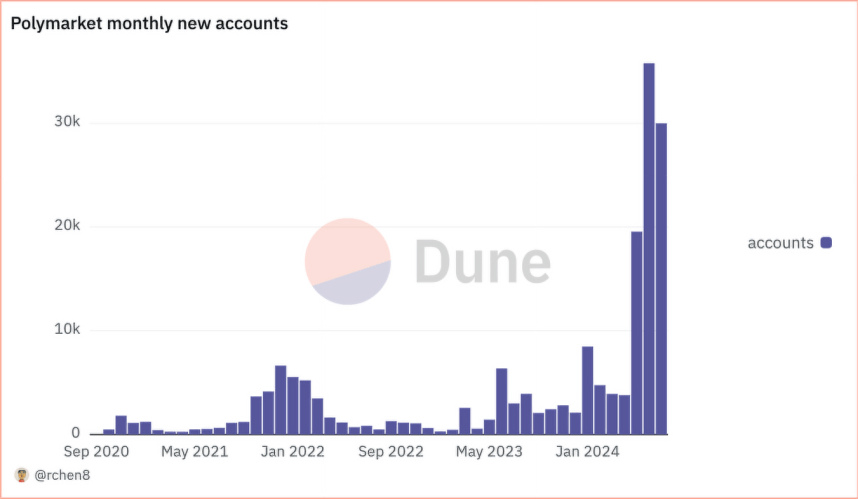
Polymarket Activity Soars with Help from US Presidential Election

Polymarket, the internet-based marketplace that allows users to wager on everything from politics to pop culture to sports to weather, is experiencing soaring interest among users — much of which is supported by the US presidential election.

Donald Trump 2024 odds assassination
Donald Trump following an assassination attempt in Butler, Pennsylvania, on Saturday, July 13, 2024. Increased interest in political betting is stoking a surge in activity on Polymarket. (Image: AP)

While 38 states and Washington, DC currently permit some form of sports wagering and seven allowed betting on the Oscars this year, political betting is prohibited in regulated markets in the US. Polymarket avoids regulatory scrutiny (mostly) because it doesn’t offer bets in the traditional sense. Rather, the cryptocurrency-based platform provides investors/bettors with an avenue to wager on outcomes by purchasing shares based on an event.

Shares on Polymarket are priced from $0 to $1 with a share trading at 50 cents implying even odds of the event occurring or not happening. Perhaps owing to unusual circumstances, including the assassination attempt on former President Trump and President Biden declaring he won’t seek a second term, Polymarket activity is surging.

Now that betting on the November election has approximated $290 million, both daily volume and number of new active traders have hit all-time highs of $20 million and 30,000, respectively,” noted ARK Invest analyst Lorenzo Valente.

Polymarket was founded by Shayne Coplan in 2018 and experienced a substantial uptick in activity during the 2020 US presidential campaign as well.

Polymarket Adding New Accounts at Rapid Pace

Bettors’ enthusiasm for Polymarket is evident in the site’s prodigious pace of new account openings over the past three months.

May marked the first time more than 10,000 new Polymarket accounts were opened. The actual number was close to 20,000. In June, the number was roughly 35,000 and as of July 19, the figure was already close to 30,000, according to Dune Analytics data.

Polymarket
Polymaket account openings are soaring thanks to help from the US presidential election. (Image: ARK Invest)

Contracts on Polymarket are purchased via the polygon cryptocurrency, which is based on the ethereum blockchain. The token has ties to some other wagering entities.

Polygon solves pain points associated with blockchains, like high gas fees and slow speeds, without sacrificing on security. This multichain system is akin to other ones, such as Polkadot, Cosmos, Avalanche, etc., according to the token’s developers.

Polymarket Could Highlight Potential of Predictive Markets

There’s no denying that sports betting has taken flight in the US, but bettors want access to new markets, including politics. Traditional, regulated gaming companies cannot provide that access, but prediction markets can and that access could be a growth driver for companies such as Polymarket.

“Prediction markets could have real staying power, thanks to platforms that not only are tamper-proof and transparent but also provide liquid bets with real-time consensus data, not to mention the “wisdom of crowds” that provide highly accurate odds,” concludes ARK’s Valente. “As distrust of legacy media increases globally, prediction markets could become “information credibility” barometers that gauge public sentiment and surface truth.”

Current popular bets on Polymarket include the winner of the presidential race, whether or not Biden will finish his term, the country that will take home the most medals at the Summer Olympics and what team will win the Super Bowl.


The post Polymarket Activity Soars with Help from US Presidential Election appeared first on Casino.org.

Station Casinos Gave Workers Free Steaks, Possibly to Sway Union Election

Just a couple of days before Station Casinos workers voted on whether to affiliate with the Culinary Union, management tried to get employees to oppose the union with the lure of tasty food.

A steak dinner
A steak dinner, pictured above, is an example of a meal Station Casinos to its workers before a union vote. (Image: Lana’s Cooking)

The company served the culinary workers more than 500 complimentary steaks in 2019. Each was branded “Vote No!”

The giveaway was in response to workers previously saying the food they had been served in a free buffet wasn’t tasty. Food had become an employee concern.

By giving out the steaks, Station Casinos was hinting meals in the future would improve if the employees rejected the union during the 2019 vote. It turned out, the workers did oppose the union by a 627-534 vote.

Company Must Negotiate

Earlier this week, the National Labor Relations Board (NLRB) further directed Station Casinos and parent company Red Rock Resorts to recognize and negotiate with the Culinary Union.

Management had taken part in “egregious and pervasive unlawful conduct” leading up to the union vote, the federal panel said.

The NLRB also claimed Station Casinos’ actions “stemmed from a carefully crafted corporate strategy intentionally designed at every step to interfere with employees’ free choice whether or not to select the [Culinary] Union as their collective-bargaining representative,” according to the federal ruling.

In response to the ruling, Culinary Secretary-Treasurer Ted Pappageorge said it “affirms what we have been saying for years — that Station Casinos violated the law and the company must bargain with the union because of its unlawful actions that corrupted the prospect for a free and fair union election.”

Vote Was Fair

Red Rock Resorts spokesman Michael Britt said the 2019 workers’ vote “was a fair outcome that reflected the wishes of a majority of the Red Rock Team Members then and reflects it now,” according to the Las Vegas Independent.

The NLRB’s decision “upheld the findings of its own NLRB hearing officer,” and wasn’t unexpected, Britt added. The company is likely to file an appeal.

The controversy involves three gaming properties, including Red Rock Resort, Palace Station, and Boulder Station.

Decertification By Workers

More than half of the approximately 600 unionized workers at Sunset Station Hotel and Casino reportedly said in April they wanted to drop the Culinary Union as their labor representative.

The employees were in the process of signing a decertification petition, according to Station Casinos. Decertification petitions were previously signed in 2020 by a majority of workers at Boulder Station and Palace Station.

Culinary Workers Union Local 226 and Bartenders Union Local 165, represent some 60K workers in Las Vegas and Reno, including guest room attendants, cocktail and food servers, porters, bellmen, cooks, bartenders, and laundry and kitchen workers.

The post Station Casinos Gave Workers Free Steaks, Possibly to Sway Union Election appeared first on Casino.org.