VEGAS MYTHS RE-BUSTED: ‘Fear and Loathing’ Really Happened

EDITOR’S NOTE: “Vegas Myths Busted” publishes new entries every Monday, with a bonus Flashback Friday edition. Today’s entry in our ongoing series originally ran on March 3, 2023. 


Hunter S. Thompson, who died by suicide 18 years ago last Monday, is famous for being a gonzo journalist. So, many of his fans regard his book, Fear and Loathing in Las Vegas, as a journal of events that actually occurred.
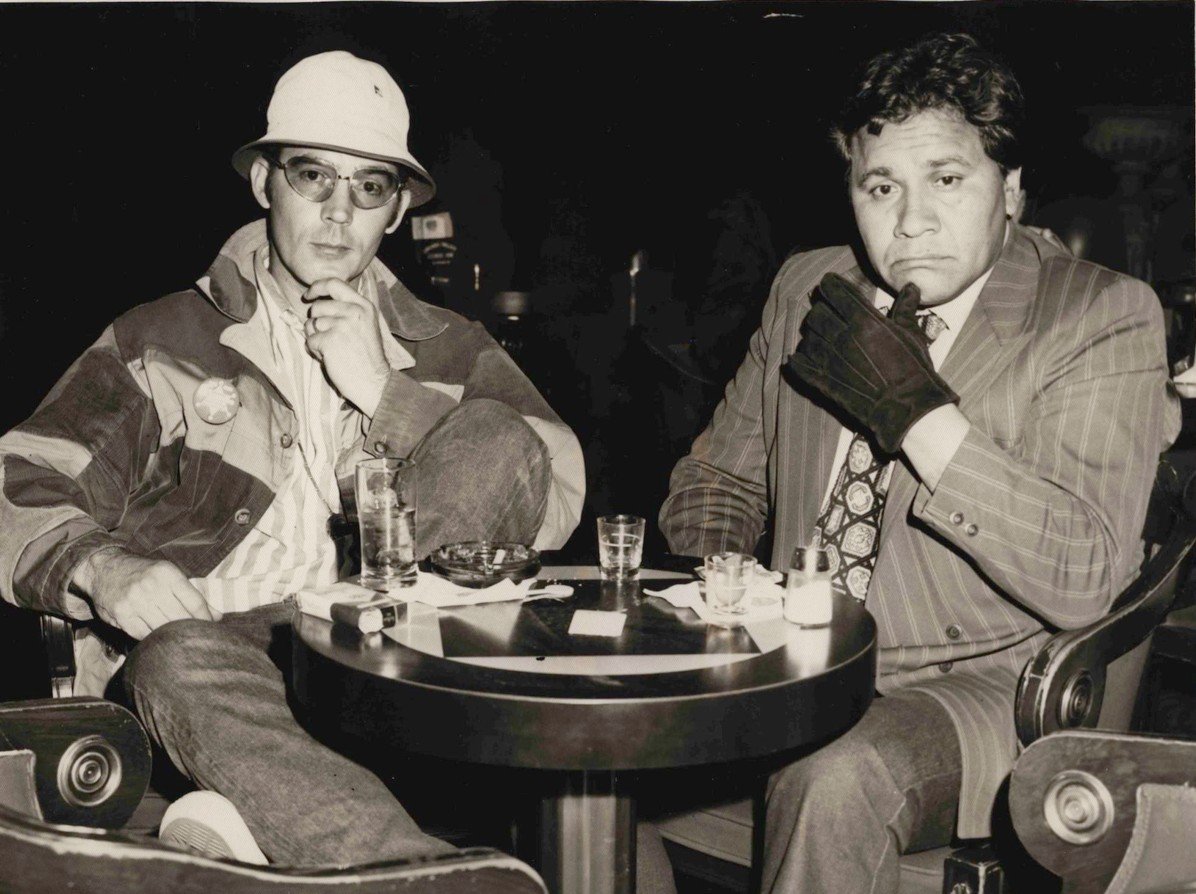
Hunter S. Thompson, Oscar Acosta
Hunter S. Thompson (left) and Oscar Acosta pose in the Baccarat Lounge at Caesars Palace in April 1971. (Image: ‘Fear and Loathing in Las Vegas’ book cover)

Actually, that’s not so much their fault, since Random House published the author’s 1972 masterwork under the category of general nonfiction. But Thompson never claimed any of the events described in it were true.

The fact that neither of his main characters was a real person should have been the first clue. The story is narrated by one Raoul Duke, whose traveling companion/attorney is Dr. Gonzo.

In real life, Thompson was assigned by Rolling Stone magazine to write an exposé on civil rights activist and Los Angeles Times columnist Ruben Salazar, whom LA County Sheriff’s officers “accidentally” shot and killed with a tear gas grenade fired at close range during a Vietnam War protest in 1970. After a week or so of asking tough questions around L.A., Thompson grew scared.

Figuring he might be next, he whisked his main source for the story, attorney Oscar Zeta Acosta, off to Las Vegas to interview him there. Sports Illustrated had hired Thompson to cover the Mint 400, an off-road vehicle race around undeveloped parts of North Las Vegas from March 21-23, 1971.

Sports Illustrated “aggressively rejected” (Thompson’s words) what he submitted as his race coverage. What was supposed to be a 250-word caption instead became a 2,500-word screed on the death of the American dream. So, Thompson instead offered it to Rolling Stone, whose editor, Jann Wenner, scheduled it to run in two parts in future issues.

More than a month later, Thompson and Acosta returned to Las Vegas. They were there to cover the National District Attorneys Association’s Conference on Narcotics and Dangerous Drugs for the second half of his Rolling Stone assignment. With only a few minor edits and the addition of the grotesquely hallucinogenic illustrations of Ralph Steadman, the magazine series became the book that would forever entwine Thompson’s name with Las Vegas. He wrote most of it in a hotel room in Arcadia, Calif., while completing Strange Rumblings in Aztlan, his Salazar article for Rolling Stone.

So how much really happened in Fear and Loathing in Las Vegas: A Savage Journey to the Heart of the American Dream? Based on interviews with witnesses and participants, somewhere around 25%.
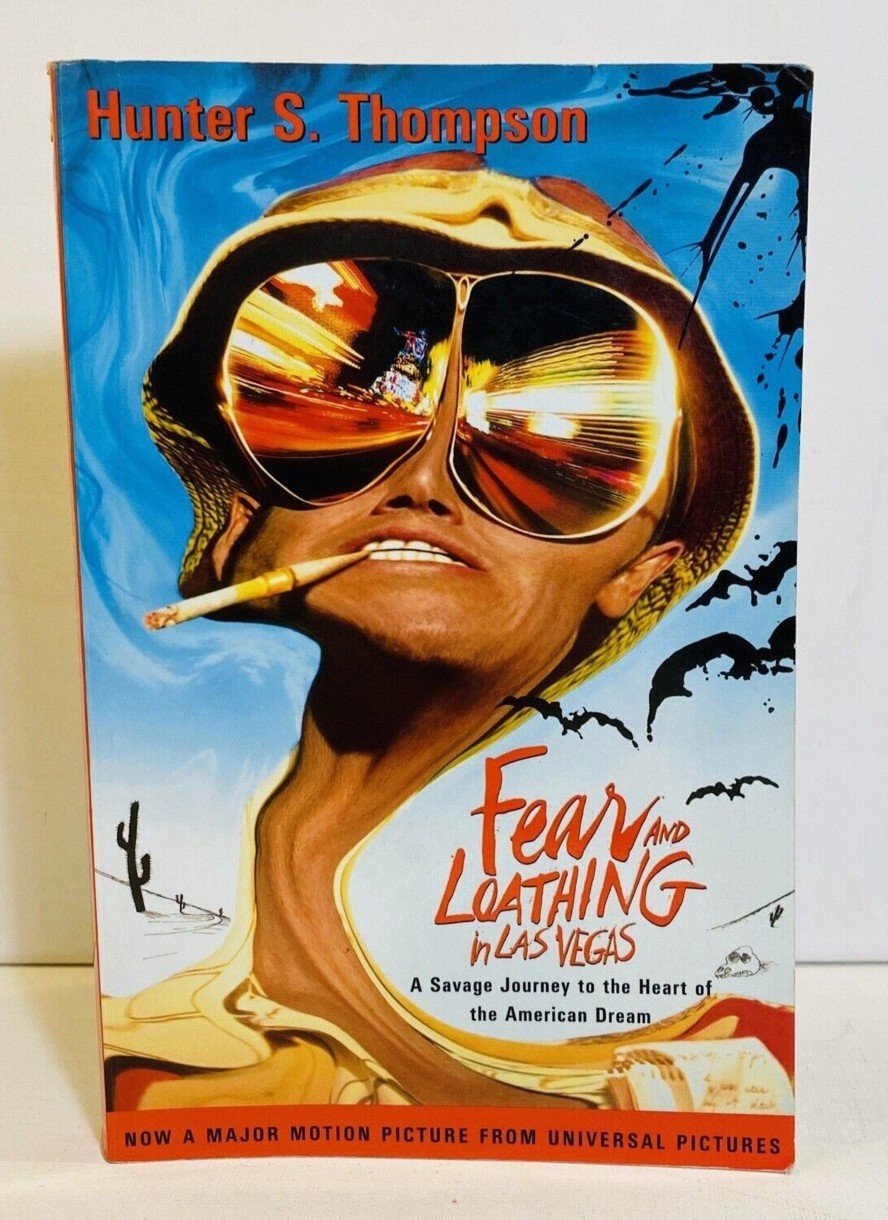
Since the release of Terry Gilliam’s phantasmagoric 1998 film adaptation of Fear and Loathing in Las Vegas,  the cover of the paperback edition has further blurred fact from fiction. It prominently features the face of actor Johnny Depp, who played Raoul Duke in the movie. (Image: eBay)

The 75% That Didn’t Happen

Let’s start with the legendary contents of Thompson and Acosta’s rental car trunk. In the book, it included “seventy-five pellets of mescaline, five sheets of high-powered blotter acid, a salt shaker half full of cocaine, and a whole galaxy of multi-colored uppers, downers, screamers, laughers, … a pint of raw ether and two dozen amyls,” all gathered during one feverish night in L.A.

This was supposedly the fuel for all the book’s misadventures.

However, in a letter to his Random House editor, published in the 1997 book, Fear and Loathing in America, Thompson admitted there was no actual drug use. The novel “was a very conscious attempt to simulate drug freakout,” he wrote, though he did “at times, bring situations & feelings I remember from other scenes to the reality at hand.” He later wrote to the same editor: ”I have never had much respect or affection for journalism.”

A good chunk of the book’s action took place in Room 1850 of The Mint’s tower (one of 365 rooms that new owner Binion’s Horseshoe permanently closed in 2009). According to Duke’s narration, he and Dr. Gonzo ran up an unpaid room service bill of $29 to $36 an hour for 48 consecutive hours before trashing their room and swiping 600 bars of Neutrogena soap.

“That is something I would have been immediately informed of, but I never heard that,” K.J. Howe, a publicity executive with the Mint at the time, told the Las Vegas Review-Journal in 2010. According to Howe, there was no “Mr. Heem” or any other hotel executive looking for Thompson, Acosta couldn’t have ordered a set of luggage from room service without paying, and no soap was reported stolen.

His concept of what was going on and what was really going on was two different things,” Howe said.

However, Thompson did get the brand of allegedly stolen soap right. (Millionaire real-estate developer Del Webb, who owned the Mint, also sat on the company’s board that made Neutrogena.) Thompson’s eye for detail could imbue an air of believability into the most obvious fantasy.

Another event that never happened is the Debbie Reynolds show at the Desert Inn, at least in the way Thompson reported it. In the book, Duke and Dr. Gonzo witness the opening number (a cover of the Beatles’ Sgt. Pepper’s Lonely Hearts Club Band) before getting bounced for having conned their way in for free.

While Reynolds did play the Desert Inn in March 1971, the singer said she was never informed of any incident resembling this. However, she was sure of one detail that casts suspicion over the entire account: never, she told the R-J, did she perform Sgt. Pepper.

Other embellishments require no witnesses to identify. For instance, the district attorneys’ conference Thompson was assigned to cover by Rolling Stone convened in late April, more than a month after the Mint 400. Yet the book places the events a week apart, joining them through an aborted trip to L.A. punctuated by a traffic stop conducted by a California Highway Patrol officer who supposedly let Thompson go after the author led him on an off-road chase, at 100 mph, with a Budweiser in hand.

“You know,” Thompson quoted the officer, “I get the feeling you could use a nap.”
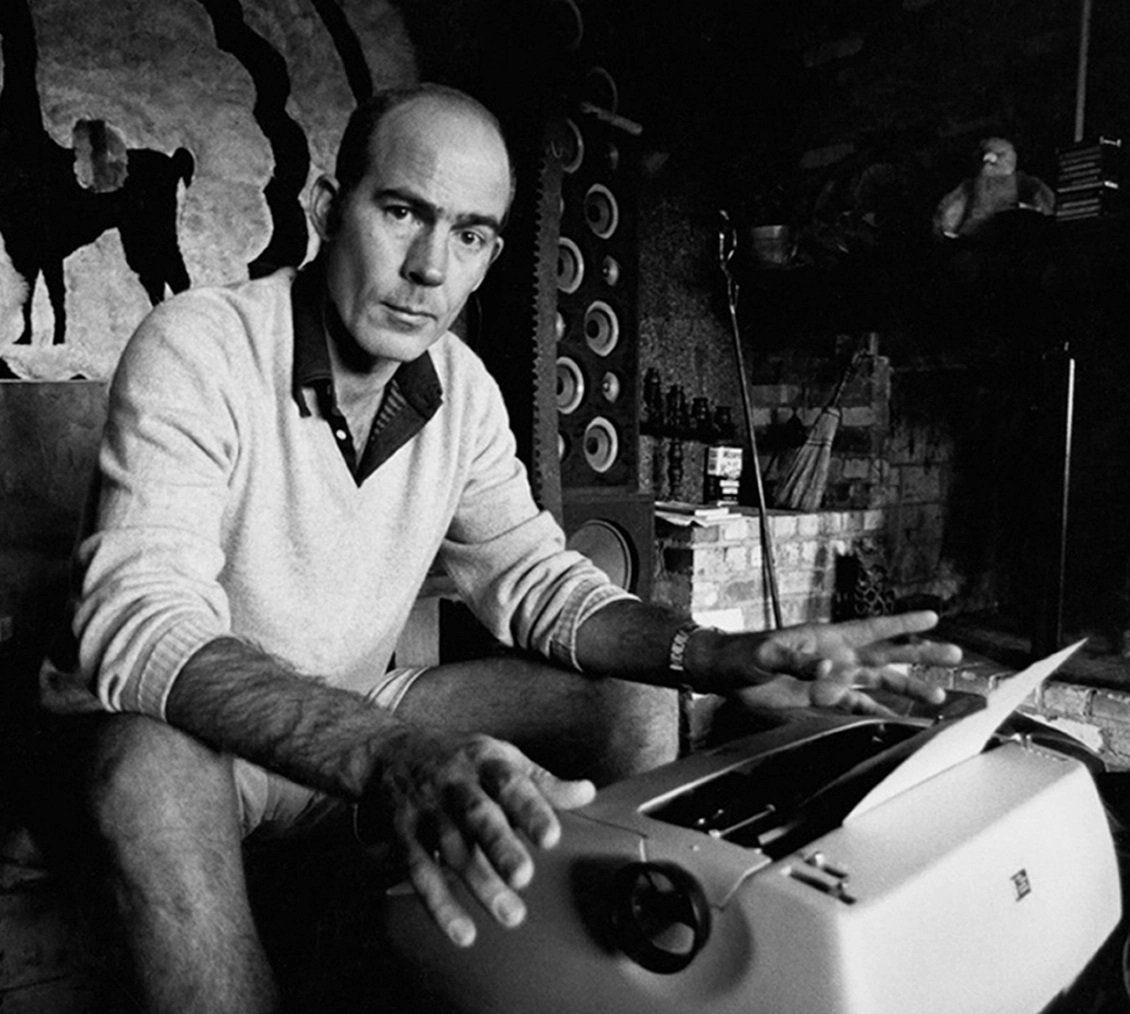
Hunter S. Thompson
Gonzo journalism, a style of reporting invented by Hunter S. Thompson, is based in part on fellow author William Faulkner’s premise that ‘the best fiction is far more true than any kind of journalism.’ (Image: Rolling Stone)

The 25% That Did Happen

In the 2008 documentary, Gonzo, Thompson and Acosta can actually be heard living out Chapter 9 as they pull into a Boulder City, Nev. taco stand during their second trip to Las Vegas.

“We’re looking for the American dream,” Acosta tells a waitress, “and we were told it was somewhere in this area.”

The waitress turns to the cook, thinking she has just been asked directions to a nightclub.

“Hey Lou,” she says, “you know where the American Dream is?”

That whole chapter is a transcription of that audiotape,” “Gonzo” director Alex Gibney told the R-J  in 2010. “So it leads you to believe that some of this stuff is real.”

For the final say, we’ll go to the horse’s mouth. Here’s a blurb from Thompson that was published on the book’s original jacket cover…

“My idea was to buy a fat notebook and record the whole thing, as it happened, then send in the notebook for publication — without editing,” Thompson wrote. “But this is a hard thing to do, and in the end, I found myself imposing an essentially fictional framework on what began as a piece of straight/crazy journalism.”

Look for “Vegas Myths Busted” every Monday on Casino.org. Visit VegasMythsBusted.com to read previously busted Vegas myths. Got a suggestion for a Vegas myth that needs busting? Email corey@casino.org.

The post VEGAS MYTHS RE-BUSTED: ‘Fear and Loathing’ Really Happened appeared first on Casino.org.
VEGAS MYTHS BUSTED: Airport Weather Station Underreports Summer Temps

The highest temperature to ever scorch Las Vegas, 120°F, was recorded at 3:38 p.m. Sunday by the National Weather Service (NWS) weather station at Harry Reid International Airport. According to many conspiracy theorists, however, the actual temperature here routinely tops that number and goes underreported at the behest of the Las Vegas Convention and Visitors Authority, which doesn’t want tourists knowing how hot Sin City really gets in the summer.

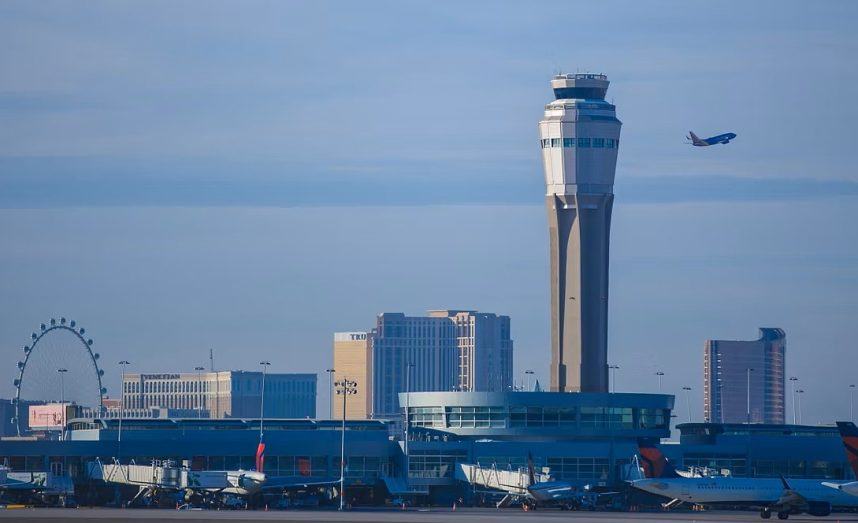
The NWS weather station at the main Las Vegas airport, named Harry Reid International since 2021, has been measuring Sin City’s official temperature since Dec. 18, 1948.  (Image: Shutterstock)

This goal supposedly gets accomplished by keeping the weather station’s temperature sensor in the shade instead of how most of those walking around Las Vegas experience the weather — in the blazing sun.

Some conspiracy theorists, such as one who commented below this recent video on the “Jacobs Life in Vegas” YouTube channel, go as far as insisting that the weather station was secretly relocated to the top of the air traffic control tower, where the air is cooler.

“Lies and misinformation,” insisted YouTube user @taylorlto806. “It’s ridiculous … The weather DOES and HAS exceeded 120 most summers, but it is no longer announced due to tourism.”

Weathering Heights

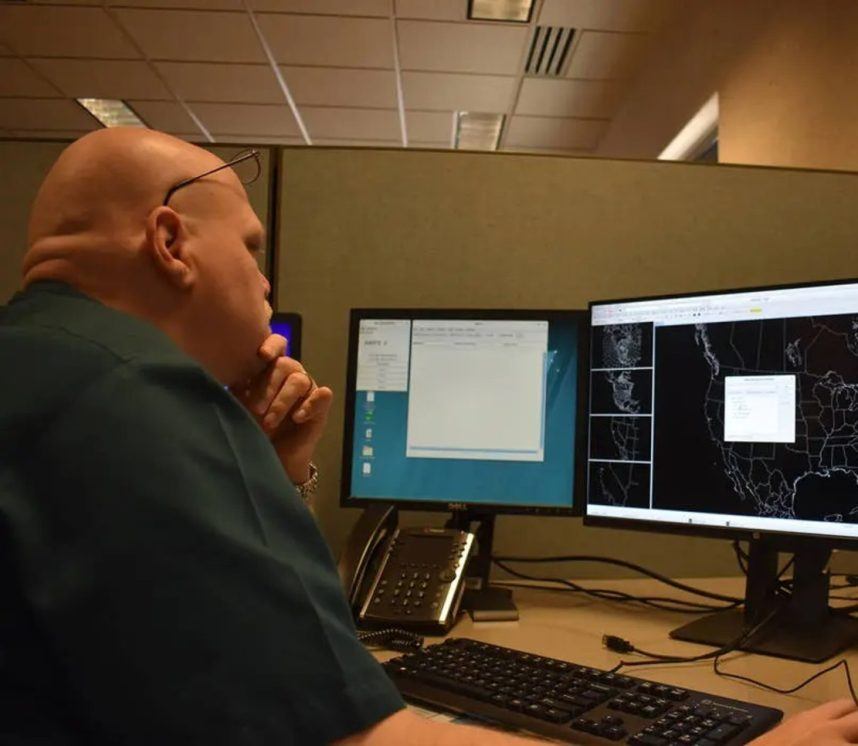
NWS meteorologist Daniel Berc monitors weather conditions to formulate a forecast in 2019. (Image: Las Vegas Review-Journal)

Yes, the temperature gauges at Harry Reid are kept in the shade. However, that’s true of all NWS weather stations.

“Historically, all temperatures are measured in the shade to be consistent, as the amount of solar radiation a location gets differs in different areas even when the temperature is the same,” NWS meteorologist Daniel Berc told Casino.org.

He added: “All official National Weather Service thermometers are kept in white, vented enclosures to reflect the sunlight. The shade, vents, and reflective paint allow the air to circulate freely so the thermometer can accurately measure the air temperature.”

Berc, who has worked in the agency’s Las Vegas office since 2012, says the air-traffic control tower theory is a new one to him. According to Berc, the official NWS Las Vegas weather station has never sat higher than five feet off the ground.

The first one began taking observations on Jan. 1, 1937, at Nellis Air Force Base. That was back when it was known as the Western Air Express Airfield and the NWS was called the US Weather Bureau.

That station was moved to Las Vegas’ civilian airport, then known as Alamo Field, on Dec. 18, 1948, two days before it was renamed to honor Senator Pat McCarran. The station was installed outside the Weather Bureau’s office at Alamo, with its sensors measuring the air at about five feet off the ground.

On Sept. 1, 1995, the weather service replaced this station with an automated weather station located a bit east of what is now the middle of the airfield — again, about five feet off the ground. Because it was automated, it no longer needed to be manually read. So NWS abandoned its airport office for its current one on Dean Martin Drive.

That weather station needed to be moved due to the construction and expansion of a new taxiway. So, since April 19, 2007, the official NWS Las Vegas weather station has operated, once again, with its sensors about five feet off the ground in the southwest corner of the airport

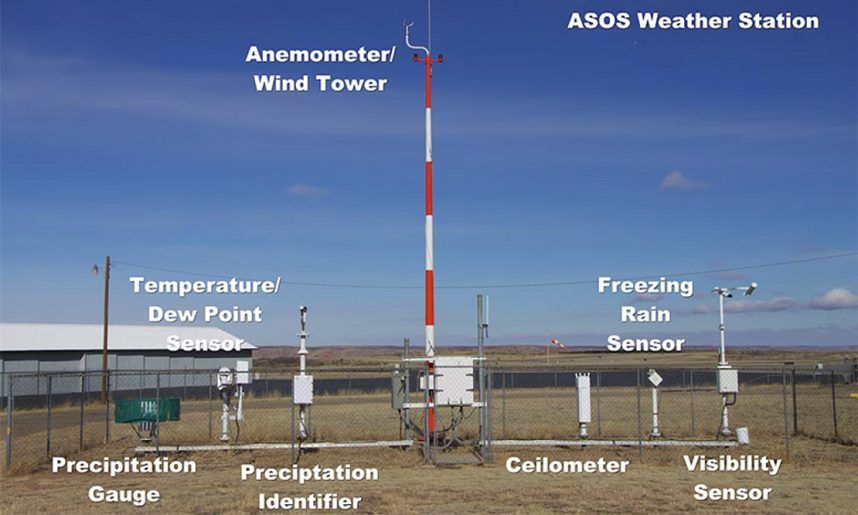
This weather station, known as an Automatic Surface Observing System (ASOS), is identical to the one operating at Harry Reid Airport. (Image: NOAA/NWS)

Of course, as any Las Vegas resident knows, the eastern side of Las Vegas, around Boulder Highway, tends to get hotter than the rest of the valley because it sits at a lower elevation. And occasional amateur readings of above 120°F may have given this myth some legs.

“While we do not have any official climate sites there, readings of 120°F or above would certainly be plausible, however rare,” Berc said.

Why Always at Airports?

Official weather stations are usually located at airports, Berc explained, because “weather is so important to the aviation community.” (Both North Las Vegas and Henderson, Nev. have airport NWS weather stations recording and reporting their official temperatures, too.)

In fact, from 1948 through 1995, Berc said, pilots would walk into the official weather office at Las Vegas airport and receive flight briefings directly from meteorologists. Then they would know they were getting the most accurate information possible.

This would distinguish those pilots of yesteryear from today’s conspiracy theorists, who get their information from social media, fake news sites, and misinformed friends and family members.

Look for “Vegas Myths Busted” every Monday on Casino.org. Visit VegasMythsBusted.com to read previously busted Vegas myths. Got a suggestion for a Vegas myth that needs busting? Email corey@casino.org.

The post VEGAS MYTHS BUSTED: Airport Weather Station Underreports Summer Temps appeared first on Casino.org.

VEGAS MYTHS BUSTED: The ‘World’s Tallest Thermometer’

The “world’s tallest thermometer” in Baker, Calif. is a liar.

It’s not that there’s a taller thermometer somewhere in the world robbed of its rightful title. It’s that the spectacle that towers over the Mad Greek Café, a dozen gas stations, and everything else in the Mojave Desert town two-thirds of the drive up Interstate 15 from LA to Vegas isn’t a working thermometer.

World's Tallest Thermometer, Baker, desert, Las Vegas
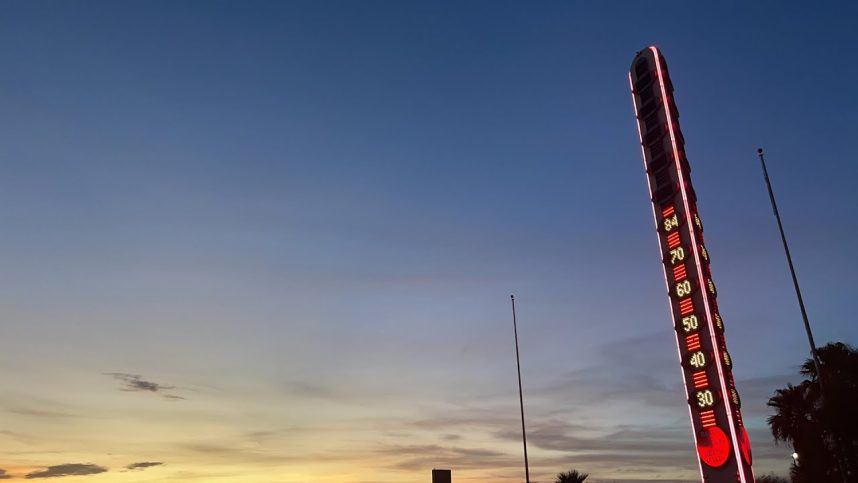
The “world’s tallest thermometer” can be seen dozens of miles away from its location in Baker, Calif. (Image: YouTube)

It’s just a three-sided digital sign that displays the temperature measured by a thermometer that is real — but much, much smaller — located somewhere inside of it.

And, as far as freestanding digital signs go, the “world’s tallest thermometer” doesn’t even make the Top 10. The current record holder, located 94 miles north of Baker in Las Vegas, is nearly three times its size. And before the MSG Sphere’s 366 foot tall LED outer skin was switched on this July 4th, the record holder was the Aria sign — also in Las Vegas — at twice the size of Baker’s digital sign.

Bun Boy, restaurant, sign, Baker
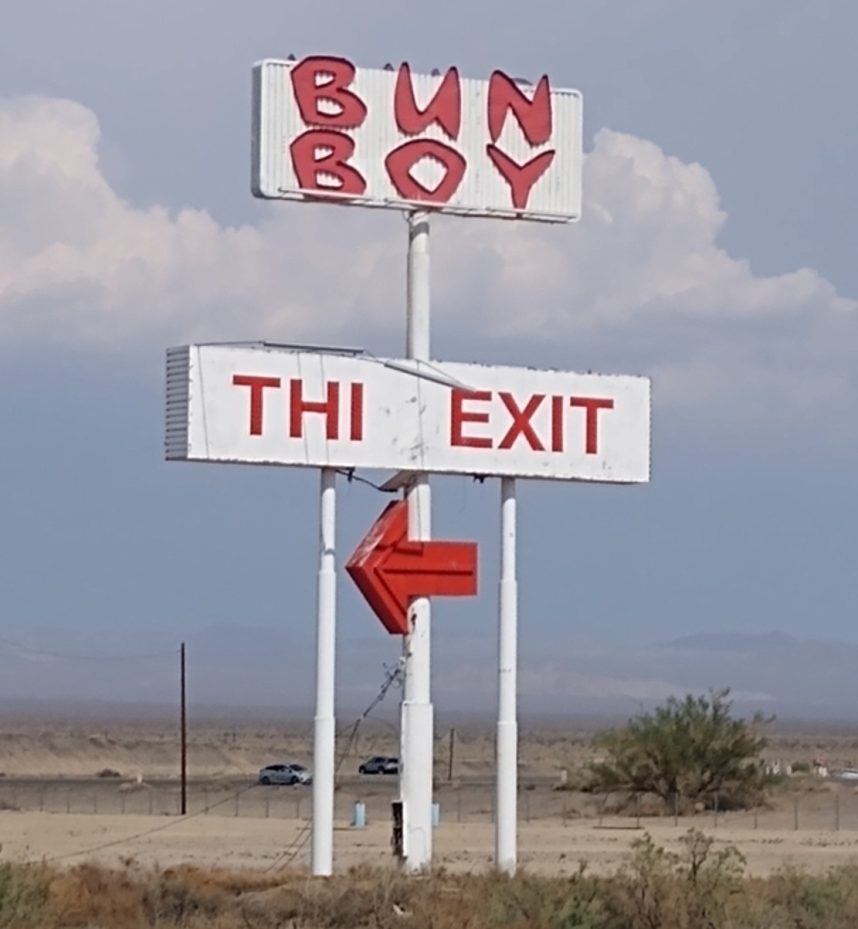
This sign wasn’t tall enough for restaurateur Willis Herron. So he conceived of a bigger idea. (Image: weirdca.com)

Bun Warmer

In 1956, Willis Herron became a co-owner of the Bun Boy on Baker Boulevard. According to its roadside sign, this restaurant was the “home of the best fresh strawberry pie & butter thin pancakes.”

When the Bun Boy burned down in 1990, Herron sought to rebuild it but to add something memorable for the public to associate it with — other than offensive jokes about the restaurant’s name.

At the time, Baker was known to the outside world for only two things — being a rest stop and being hot as blazes. So Herron threw in with the latter, and paid YESCO $700K to do its thing. (The Salt Lake City-based Young Electric Sign Co. built Vegas Vic and owns and operates the Welcome to Fabulous Las Vegas sign.)

The resulting sign featured 5,000 incandescent light bulbs and stood 134 feet tall. That wasn’t coincidental. It’s because 134 degrees was the highest official temperature ever recorded on Earth — set in neighboring Death Valley on July 10, 1913. (Click here for a trip into the weeds about whether that record may have also been a myth.)

After it was built but before it was switched on, Herron’s sign was snapped in two by 70 mph winds that also trashed a gift shop below it. It was rebuilt and 125 cubic yards of concrete were poured into its steel core as reinforcement. Opening day was Oct. 9, 1992.

World's Tallest Thermometer, Baker, desert, Las Vegas, tourist attraction
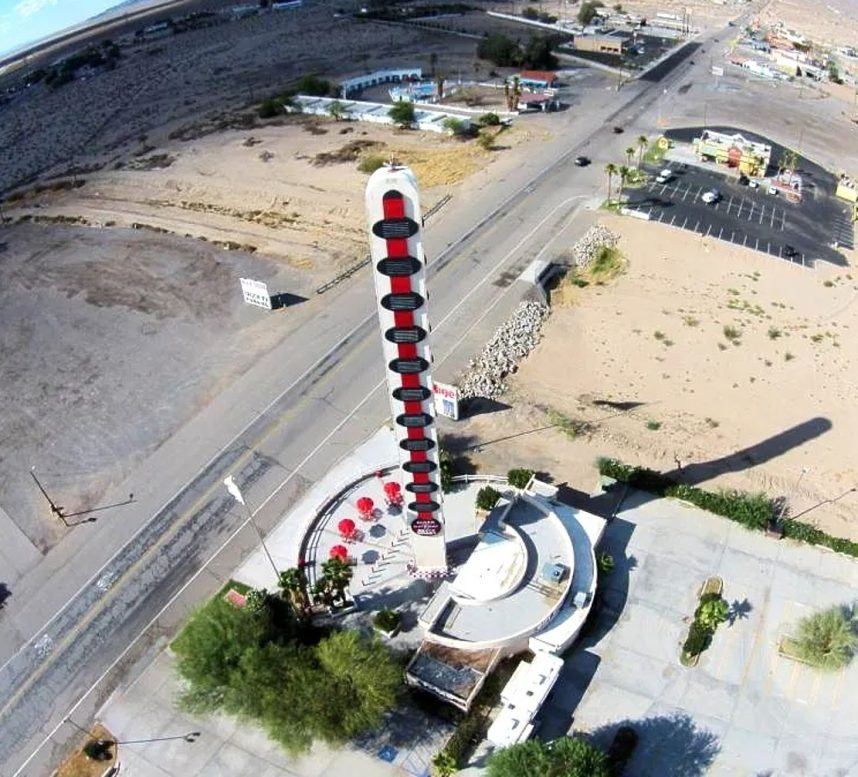
Baker, Calif.’s biggest tourist attraction as photographed by a drone. (Image: worldrecordacademy.org)

Under the Weather

Eight years later, an ailing Herron sold his thermometer — along with his Bun Boy and an associated motel — to a Burger King franchisee. Five years after that, the franchisee sold them to a local businessman named Matt Pike. Pike turned the Bun Boy into a Bob’s Big Boy and, in 2012, switched off the fake giant thermometer to save on its very real giant electric bill: $8K a month.

Yet saddened tourists still stopped to take photos of darkened sign. So Herron’s widow vowed to buy it back.

Though Pike’s $1.75 million asking price was too steep, a foreclosure and a court order by a federal judge intervened. In a ceremony attended by all 916 Baker residents two years later, Barbara Herron switched her late husband’s crowning achievement back on. Only now, it used energy-saving LEDs.

After Barbara died in 2022, ownership of the sign passed to her children.

Bonus Tall Tale

Because the temperature in Death Valley was never expected to top 134 degrees Fahrenheit, that’s supposedly the highest temperature the sign is capable of displaying.

Nope. This is also a myth, because the sign can go up to 139 degrees.

“The digital readout is set up to go up by ten-degree increments between the balls,” LaRae Harguess, one of the Herron children, told Casino.org. “The highest ball is 130, so 139 is the highest it will go, since there isn’t a 140 ball.”

Could a new computer program be written written to accommodate even higher temperatures caused by global warming?

“Not without changing everything,” Harguess said.

Look for “Vegas Myths Busted” every Monday at Casino.org. Visit VegasMythsBusted.com to read previously busted Vegas myths. Got a suggestion for a Vegas myth that needs busting? Email corey@casino.org.

The post VEGAS MYTHS BUSTED: The ‘World’s Tallest Thermometer’ appeared first on Casino.org.