VEGAS MYTHS BUSTED: Airport Weather Station Underreports Summer Temps

The highest temperature to ever scorch Las Vegas, 120°F, was recorded at 3:38 p.m. Sunday by the National Weather Service (NWS) weather station at Harry Reid International Airport. According to many conspiracy theorists, however, the actual temperature here routinely tops that number and goes underreported at the behest of the Las Vegas Convention and Visitors Authority, which doesn’t want tourists knowing how hot Sin City really gets in the summer.
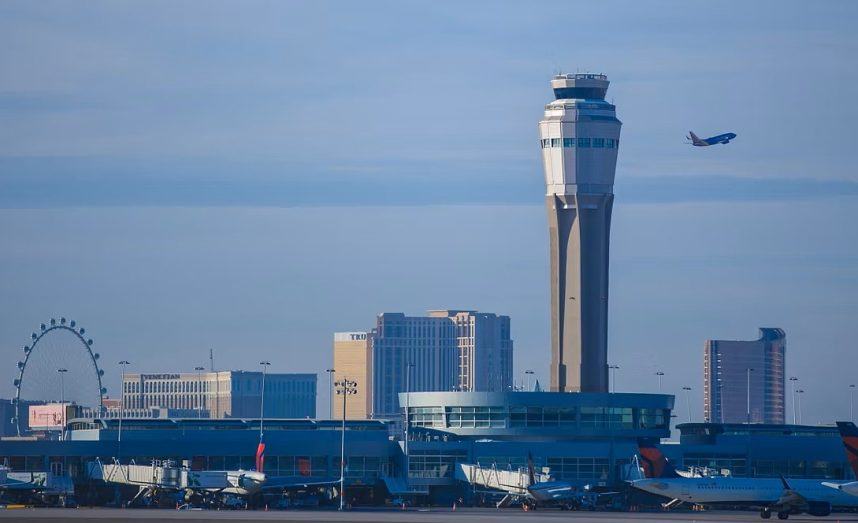
The NWS weather station at the main Las Vegas airport, named Harry Reid International since 2021, has been measuring Sin City’s official temperature since Dec. 18, 1948.  (Image: Shutterstock)

This goal supposedly gets accomplished by keeping the weather station’s temperature sensor in the shade instead of how most of those walking around Las Vegas experience the weather — in the blazing sun.

Some conspiracy theorists, such as one who commented below this recent video on the “Jacobs Life in Vegas” YouTube channel, go as far as insisting that the weather station was secretly relocated to the top of the air traffic control tower, where the air is cooler.

“Lies and misinformation,” insisted YouTube user @taylorlto806. “It’s ridiculous … The weather DOES and HAS exceeded 120 most summers, but it is no longer announced due to tourism.”

Weathering Heights

NWS meteorologist Daniel Berc monitors weather conditions to formulate a forecast in 2019. (Image: Las Vegas Review-Journal)

Yes, the temperature gauges at Harry Reid are kept in the shade. However, that’s true of all NWS weather stations.

“Historically, all temperatures are measured in the shade to be consistent, as the amount of solar radiation a location gets differs in different areas even when the temperature is the same,” NWS meteorologist Daniel Berc told Casino.org.

He added: “All official National Weather Service thermometers are kept in white, vented enclosures to reflect the sunlight. The shade, vents, and reflective paint allow the air to circulate freely so the thermometer can accurately measure the air temperature.”

Berc, who has worked in the agency’s Las Vegas office since 2012, says the air-traffic control tower theory is a new one to him. According to Berc, the official NWS Las Vegas weather station has never sat higher than five feet off the ground.

The first one began taking observations on Jan. 1, 1937, at Nellis Air Force Base. That was back when it was known as the Western Air Express Airfield and the NWS was called the US Weather Bureau.

That station was moved to Las Vegas’ civilian airport, then known as Alamo Field, on Dec. 18, 1948, two days before it was renamed to honor Senator Pat McCarran. The station was installed outside the Weather Bureau’s office at Alamo, with its sensors measuring the air at about five feet off the ground.

On Sept. 1, 1995, the weather service replaced this station with an automated weather station located a bit east of what is now the middle of the airfield — again, about five feet off the ground. Because it was automated, it no longer needed to be manually read. So NWS abandoned its airport office for its current one on Dean Martin Drive.

That weather station needed to be moved due to the construction and expansion of a new taxiway. So, since April 19, 2007, the official NWS Las Vegas weather station has operated, once again, with its sensors about five feet off the ground in the southwest corner of the airport
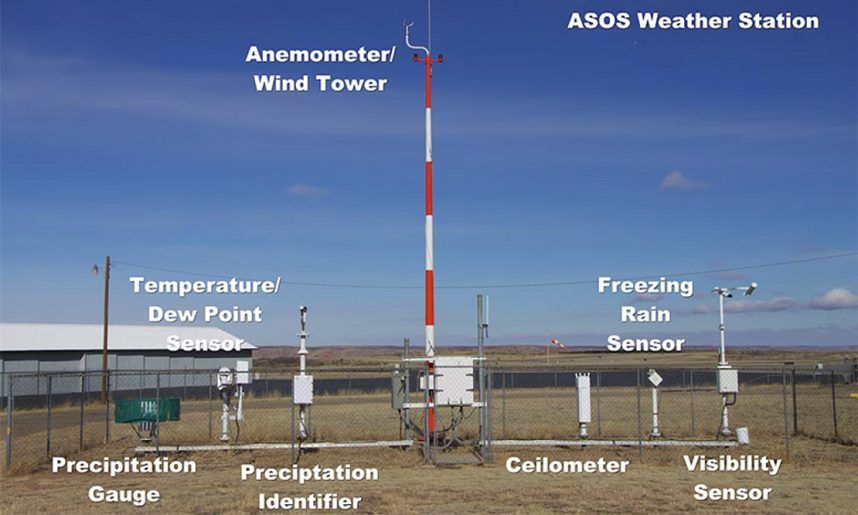
This weather station, known as an Automatic Surface Observing System (ASOS), is identical to the one operating at Harry Reid Airport. (Image: NOAA/NWS)

Of course, as any Las Vegas resident knows, the eastern side of Las Vegas, around Boulder Highway, tends to get hotter than the rest of the valley because it sits at a lower elevation. And occasional amateur readings of above 120°F may have given this myth some legs.

“While we do not have any official climate sites there, readings of 120°F or above would certainly be plausible, however rare,” Berc said.

Why Always at Airports?

Official weather stations are usually located at airports, Berc explained, because “weather is so important to the aviation community.” (Both North Las Vegas and Henderson, Nev. have airport NWS weather stations recording and reporting their official temperatures, too.)

In fact, from 1948 through 1995, Berc said, pilots would walk into the official weather office at Las Vegas airport and receive flight briefings directly from meteorologists. Then they would know they were getting the most accurate information possible.

This would distinguish those pilots of yesteryear from today’s conspiracy theorists, who get their information from social media, fake news sites, and misinformed friends and family members.

Look for “Vegas Myths Busted” every Monday on Casino.org. Visit VegasMythsBusted.com to read previously busted Vegas myths. Got a suggestion for a Vegas myth that needs busting? Email corey@casino.org.

The post VEGAS MYTHS BUSTED: Airport Weather Station Underreports Summer Temps appeared first on Casino.org.
Atlantic City Kicks off Summer Season Strong, May Casino Revenue Climbs Five Percent

Atlantic City casinos experienced a robust start to its summer season, loosely defined as Memorial Day through Labor Day.

Atlantic City casino revenue New Jersey
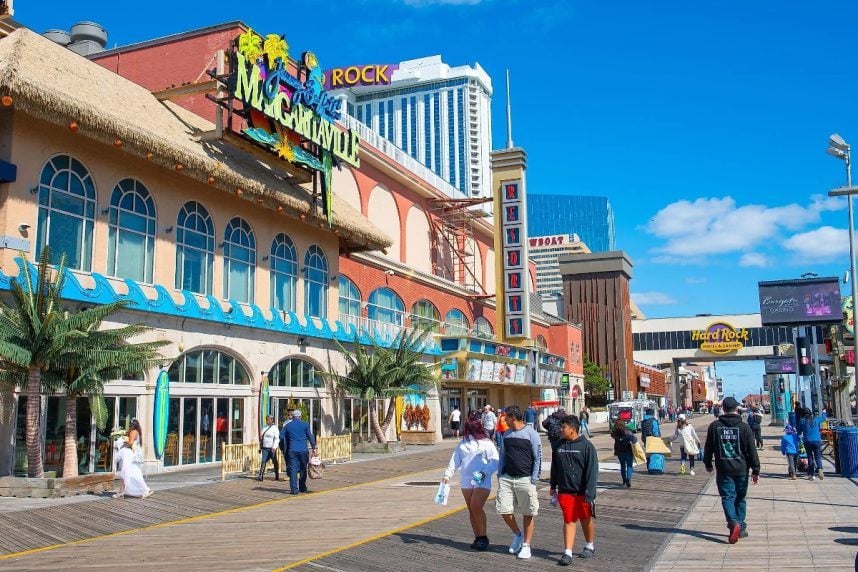
Temperatures are rising in Atlantic City and the gaming action is heating up, too. May 2024 retail gross gaming revenue down the shore in New Jersey totaled $239.1 million. (Image: Shutterstock)

Gross gaming revenue (GGR) at the nine brick-and-mortar casinos in May 2024 totaled $239.1 million, a 5.2% year-over-year improvement. Revenue from retail slot machines increased 4.8% to $181.2 million while table game hold jumped 6.4% to $57.9 million.  

The casinos’ partnered iGaming platforms continued to grow their businesses. Online slots and tables, plus rake from poker games, totaled $192 million, 19% better than May 2023. Oddsmakers were the lone vertical in the red, as sports betting win fell 4.2% to $78.7 million.

In total, New Jersey’s gaming industry generated GGR of nearly $510 million last month, an 8.3% betterment.

Atlantic City’s total gaming revenue in May showed continuing stability with positive results in all three components — casino win, internet gaming win, and sports wagering revenue,” said James Plousis, chair of the New Jersey Casino Control Commission. “Casino win recorded its best May result in eleven years, aided by the best slot machine win since 2012.”

The $192 million won by online casinos represented iGaming’s second-best month ever in the Garden State.

Market Momentum

Plousis told Casino.org that statewide GGR from January through May totaled $2.567 billion, 13.1% richer than the same five-month period in 2023. He said this year was the industry’s fastest ascent in eclipsing $2.2 billion in GGR in more than a decade.

May also provides optimism for the beach town as schools let out and families begin the summer vacation season.

“May provided a promising start for the summer season and positive momentum has been building,” Plousis said. “Consumer interest has been strong, driven by must-see unique investments recently made in the casino hotels.”

Plousis concluded by saying the diversified casinos “are providing abundant reasons for summer tourists to visit and stay.”

Though revenue is increasing, gaming analysts say Atlantic City’s casinos remain under difficult operating conditions.

While revenues increased, so have expenses, and while revenues for the month and year-to-date compare favorably to prior periods, they may not translate into similar increases in gross operating profit down the line,” Jane Bokunewicz, director of the Lloyd D. Levenson Institute of Gaming, Hospitality, and Tourism (LIGHT) at Stockton University, told the Associated Press.

“Inflation impacts both operators, in the form of costs of goods and wages, and consumers, in the form of prices. So, it is especially interesting that, even in times of inflationary pressure, consumers still seem willing to spend their discretionary money with New Jersey’s casino operators,” Bokunewicz explained.

Borgata Dominating Market

MGM Resorts’ Borgata in the city’s Marina District has long been the top-performing casino in Atlantic City.

Borgata extended its stronghold in May with $61.4 million in revenue on its physical floor, $43.9 million from its iGaming partners, and $5.6 million from its sportsbooks for a combined haul of approximately $110.9 million.

Resorts was second at combined GGR of $84.9 million, with the bulk of the casino’s win — $71.4 million — coming from its online gaming and sports betting operations.

As for brick-and-mortar GGR, Borgata’s $61.4 million lead was followed by Hard Rock with $49.9 million. Ocean was third at $32 million, Tropicana was fourth at $20.1 million, Harrah’s was fifth at $18.2 million, Caesars was sixth at $18 million, Resorts was seventh at $13.6 million, Golden Nugget was eighth at $13.5 million, and Bally’s was the bottom feeder at $12.4 million.  

The post Atlantic City Kicks off Summer Season Strong, May Casino Revenue Climbs Five Percent appeared first on Casino.org.

Curacao Online Casino License Changes Coming End of Summer

curacao_online_casino_license_changes_coming_end_of_summerChanges are coming to the online gambling jurisdiction of Curacao with a new law coming into effect soon. For background and a frame of reference, readers can find more information at the end of this article.


Beginning September 1, all new licenses will be issued by the Curaçao Gaming Control Board (GCB).

At a recent iGB LIVE (iGaming Business conference) Curaçao’s Ministry of Finance, Sixienne Jansen laid out how the online gaming licenses issued by the jurisdiction of Curacao will function beginning on September 1, 2023, under Curacao’s National Ordinance for Games of Chance (LOK).

LOK is Not Yet the Law of the Land

It’s important to note that the LOK is not yet the “law of the land” but binding agreements exist between Curacao and Amsterdam for its content and full implementation. After August this year, new licenses will be issued to the Master License holders under new rules, even though the LOK has not been introduced into parliament yet. In order to ensure continuity, all four Master License holders will automatically receive one of the new licenses on September 1. The license will be provisional and valid for one calendar year.

The LOK will reform how online gambling licensing will work for foreign operators. Nearly all licensed offshore casinos accessible to players in the United States are licensed in and regulated by Curacao.

Under the current law, there are four Master License holders in Curacao and those license holders can issue “sub-licenses” for operators of any game of chance or skill – whether it is poker, table games, bookmaking, online casinos, lottery, or any other form of remote gambling. By some estimates there could be as many as 12,000 gambling operators licensed in Curacao. However, the number of active operators is most likely much smaller

The Curacao government plans to change the entire system in a phased reform without disrupting current business operations.

According to Jansen: “No operator is going to have to pause or stop any business as a result of anything done by the Ministry. One of the primary elements of the transitions into the new regime is to facilitate uninterrupted continuity of all operations of sublicense holders.

When the LOK actually becomes law, all “sub-licensed” operators will only have 90 days to apply for a new license without regard to any time remaining on their former license. However, Master Licensers will no longer issue any new permits and all interim or provisional licenses will be issued directly by the Curaçao Gaming Control Board (GCB). Those licenses will automatically convert into LOK licenses later on.

New Regime to Comply With International Standards

However, the new regime will be a bit tighter to conform more to international standards. While current license holders already have specific obligations and are investigated by the Master License holders, three forms must be submitted by operators under the LOK whereas the application process under the current regime has never been fully explained to the public.

  • Online Gambling Application:
  • Personal Declaration:
  • Corporate Disclosures:

Once an applicant has satisfied the GCB in terms of the forms and documentation submission, then a license will be issued,” Jansen said.

Within 6 months of that license audited policies and procedures will need to be submitted for evaluation.

The same regulations that apply now will continue to be binding during a 9-month transitional phase so there should be no disruption of business practices for operators.

Jansen explained that operators who don’t wish to participate in the new regime will have ¾ of a year to wind up their businesses under existing regulations: “For those operators who do not wish to move to the new licensing regime, they can continue to conduct business up until the date the relevant master license expires,” said Jansen.

A summary of points regarding the new licenses includes the following:

  • Licenses issued from September 1 will be issued by the GCB under current legislation and regulations and will not immediately be controlled by the LOK as it is not yet the “law of the land”.
  • Sub-licenses will not be issued by the GCB, however, they will still be available from master License holders from September 1, 2023, until the LOK is implemented.
  • New provisions addressing anti-money laundering and responsible gambling will become known to the public as they will be part of the new licenses.
  • Current license holders or those with approval in process should consult with their master licenser for more information on how to proceed – this includes operators whose licenses are currently “on hold”.

Business as Usual – For Now – As Operators Go – New Process Coming

“Contrary to much speculation, there has been no change whatsoever to the legislation or permissions since the minister publicly announced the drafting of the new legislation last November,” said Jansen.

One point bears repeating:
Beginning September 1, all new licenses will be issued by the Curaçao Gaming Control Board (GCB).

The Minister is expected to issue further guidance and more updates in September as well as a new fee structure for operators.

More Information on Curacao Gambling Law

Curacao is an online gambling website license provider and casino regulator with an antiquated and semi-transparent framework that is little understood by laymen and government officials in other nations. In a nutshell, the government has issued “Master Licenses” to four Master Licensers who then accept or reject individual gambling operators and issue “sub-licenses” to online casinos, bookmakers, and other remote gambling providers.

More background on the former “Netherlands Antilles” island shows the difficulty in whether to even call it a country or to explain its relationship with the Netherlands, its independence, or its obligations to the Dutch government.

The following is from Wikipedia and is known to be a true statement: “Following a referendum, and as a result of constitutional change, Curaçao became a constituent country within the Kingdom of the Netherlands on October 10, 2010.

The further background shows that since that time the kingdom and the government in Amsterdam have wrestled with how to modernize gambling law there and more recently, to bring it more in line with how regulation and gambling law enforcement functions in other jurisdictions.

The Netherlands is a parliamentary democracy. Dutch people can choose who represents them in parliament. The Netherlands is also a constitutional monarchy.

Further complicating the push for reforms from the Dutch government includes the following fact:
Curaçao has full autonomy on most matters, with the exceptions summed up in the Charter for the Kingdom of the Netherlands under the title “Kingdom affairs”.

It wasn’t until the small island constituency needed assistance from Amsterdam during the world health emergency of the Covid pandemic that the Dutch government was able to exert enough influence over Curacao to “encourage” them to change the way gambling regulation and enforcement is handled and to get them on a timeline to implement those changes.

It is also important to note that the Netherlands itself has only recently reformed its online gambling laws.

The UK’s Law Review is a well-known and trusted website with specific and well-cited information on gambling law around the world. Lawyers there state the following about Dutch online gambling law:
As of 1 April 2021, remote gambling licenses are available for casino games and sports and horse race betting.

A more transparent regulatory framework with public and private assurances that it is in line with international standards can only be a good thing for Curacao. More accountability in regard to responsible gambling measures can only improve the player experience. However, until a process for complaints is outlined by the CGB and it is shown to be working on behalf of players, perceptions are not likely to change much.

If the CGB is no more responsive than most of the Master License holders have been to “small” complaints, it will have been an exercise in futility and lip service to the problem of murky terms and conditions including “gotcha” and “God” clauses. As it stands now, only a serious breach of licensing terms will be investigated and the public has no direct knowledge of what those terms might be and rarely if ever learns the result of an intervention.

Source: Curaçao: All master licences to get one-year extension, iGaming Business, July 12, 2023

The post Curacao Online Casino License Changes Coming End of Summer appeared first on Casino News Daily.