Mississippi Casino Project in East Biloxi in Jeopardy, Jackson Gaming Bill Rescinded

It was a busy week in the Mississippi State Capitol regarding gaming matters. One powerful lawmaker proposed allowing a commercial casino resort in Jackson, while other legislation stands to block a proposed $300 million gaming development on the Gulf Coast.
Mississippi casino tidelands bill
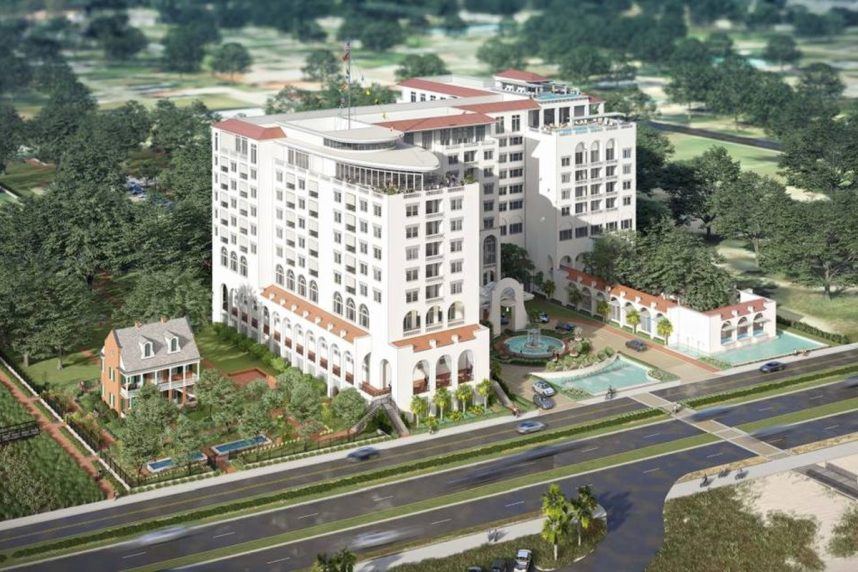
A rendering of the Tullis Garden Hotel in Mississippi includes a replica of the Tullis Manor that was destroyed by Hurricane Katrina. The development, which is to include a casino, remains in jeopardy as state lawmakers consider a tidelands lease bill. (Image: Frank Genzer Architects)

Mississippi House Ways and Means Committee Chair Trey Lamar (R-Lafayette) on Monday introduced a bill motioning to allow a casino in Jackson, the state capital. The pitch seemingly faced long odds from the onset, as Mississippi’s gaming industry for decades has been confined to the Coast and Mississippi River.

Lamar’s casino pitch would have allowed the stakeholders behind the state’s current commercial casinos to bid on a resort opportunity in the state capital. Mississippi is currently home to 12 casinos on the Gulf and 14 along the Mighty Mississippi. The state is also home to three Native American gaming facilities.

Lamar quickly fielded pushback for his enthusiasm to bring a casino to the central part of the state. After determining that he didn’t have the votes needed in the 122-member chamber, the Republican folded and rescinded the bill, but says he will resume the fight next year.

Vicksburg Opposition

Jackson is Mississippi’s most populated city with about 144K residents.

Named for General Andrew Jackson, a war hero in the War of 1812’s Battle of New Orleans who subsequently became the seventh president of the United States, Jackson’s population continues to decline. The U.S. Census Bureau says Jackson saw the largest exodus between the 2010 and 2020 censuses of any major US city.

Lamar’s casino bill projected that a gaming resort would generate more than 1,000 jobs and provide new local tax revenue for city improvement projects. But casinos in Vicksburg and state reps from the city located about 50 miles west of the capital — the closest gaming destinations — were quick to oppose Lamar’s capital city casino campaign.

The Coast may survive it, but there’s no way anybody else could,” said House Leader Robert Johnson (D-Natchez) of a Jackson casino’s impact on current gaming markets.

“It would have been devastating,” added Rep. Oscar Denton (D-Vicksburg).

Tide Lease Bill

After Hurricane Katrina, the state amended its riverboat laws to allow land-based gaming along the Gulf. However, the brick-and-mortar gaming spaces must be located within 800 feet of the 19-year mean high water line average.  

The Mississippi Supreme Court last year ruled that counties along the Gulf have the authority to sell lands that butt up against tidelands that are owned by the state. They can do so without first obtaining a tidelands lease from the state. The vital ruling paved the way for businessman Ray Wooldridge’s long-stalled casino project at the intersection of Veterans Ave. and Beach Blvd. to move forward.

As a result of the ruling, state lawmakers are considering legislation that would require casino sites to have state tidelands leases. The bill is currently in a House conference committee that’s trying to iron out differences between the two legislative chambers.

Along with Woolridge’s development, the legislative outcome could determine whether a $300 million casino scheme called Tullis Garden in East Biloxi advances. The developers of the project have an agreement with Biloxi to purchase the eight-acre site from the city, which would include access to the tidelands to qualify the project for gambling.

The state’s current gaming interests are thought to be lobbying for the state tidelands bill to give Jackson more control and prevent further competition from coming to the Gulf. Gross gaming revenue along the Gulf Coast last year was down nearly 1%.

The post Mississippi Casino Project in East Biloxi in Jeopardy, Jackson Gaming Bill Rescinded appeared first on Casino.org.

New Mississippi Coast Casino Gets Gaming Green Light

The Mississippi Gaming Commission on Thursday green-lighted a gaming development called South Beach Casino & Resort. The project targets about four acres of land located at 6081 S. Beach Blvd. in Bay St. Louis.

Silver Slipper Casino, Mississippi
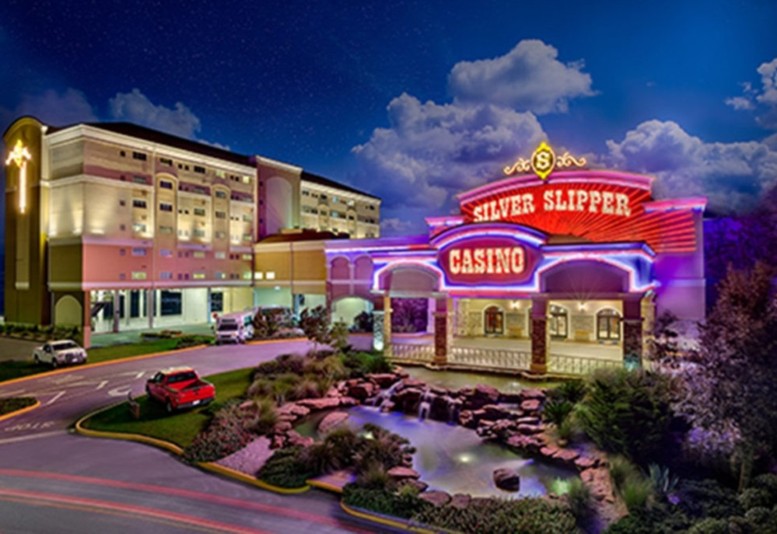
The Silver Slipper Casino Hotel in Bay St. Louis, Miss. The casino could someday have a nearby competitor, as a casino has been green-lighted by the state for vacant land just east of it. (Image: baystlouisoldtown.com)

The license was granted to Kirk D. Ladner of Diamondhead and Russell Elliott of Bay St. Louis. Ladner’s LinkedIn profile says he’s the president of Kirk Ladner Excavating, a Gulfport-based general contractor. Information regarding Elliott’s profession wasn’t immediately available.

The South Beach Casino was approved to feature a 40K gaming floor with 1.1K slot machines, 25 table games, and six poker tables. That’s according to a notice of intent to apply for a gaming license, which was published by Ladner and Elliott, as legally required, in a local newspaper.

South Beach Casino would be built onshore, but would remain within 800 feet of the 19-year high-water line as defined by the Mississippi Code. After Katrina, the state allowed its riverboats to move inland so long as the new gaming structures remained within 800 feet of their original barges. New casinos must be within 800 feet of the high-water mark.

There are currently only two commissioners on the state’s gaming commission, Tom Gresham and Francis Lee, both of whom voted in favor of the approval. (Kent Nicaud, CEO of Memorial Hospital at Gulfport, has been nominated by Mississippi Governor Tate Reeves to complete the vacant term left by chair Al Hopkins, who died earlier this year.)

One Small Problem

Ladner and Elliott have yet to secure financing. Ladner told gaming commissioners that obtaining site approval first would make the funding process easier.

In 2004, Ladner and Elliott applied to license the same casino under the same name in the same place. However, they withdrew the application during the second step of the casino development process — the step in which applicants are required to show that they have the funding to complete the casino they were licensed for.

This is not an uncommon problem on the Mississippi Coast, which has 12 casinos across Hancock and Harrison counties, with several more are proposed for Biloxi, Long Beach, and D’Iberville. Twice as many as that were approved, but more than 20 casino developers who received site approvals have been unable to secure financing since Hurricane Katrina devastated the region in 2005.

Though Mississippi’s gaming industry has more than rebounded from the pandemic — generating gross gaming revenue (GGR) in 2021 of almost $2.7B, the state’s highest gaming win since 2008 — banks and investors remain hesitant to open their wallets for new casino projects in the Gulf. Even the rock legends KISS couldn’t win over enough investors to help renovate the former Margaritaville Casino into a $200M rock n’ roll-themed gaming and entertainment destination called Rock & Brews Casino.

In fact, only one new company was able to nudge their approved casino concept into reality: the Margaritaville Casino, overlooking the Biloxi Back Bay, and that has since closed.

Elliott and Ladner have until 2026 to build the South Coast Casino & Resort.

The post New Mississippi Coast Casino Gets Gaming Green Light appeared first on Casino.org.

Filling Lake Mead with Mississippi River Water No Longer a Pipe Dream

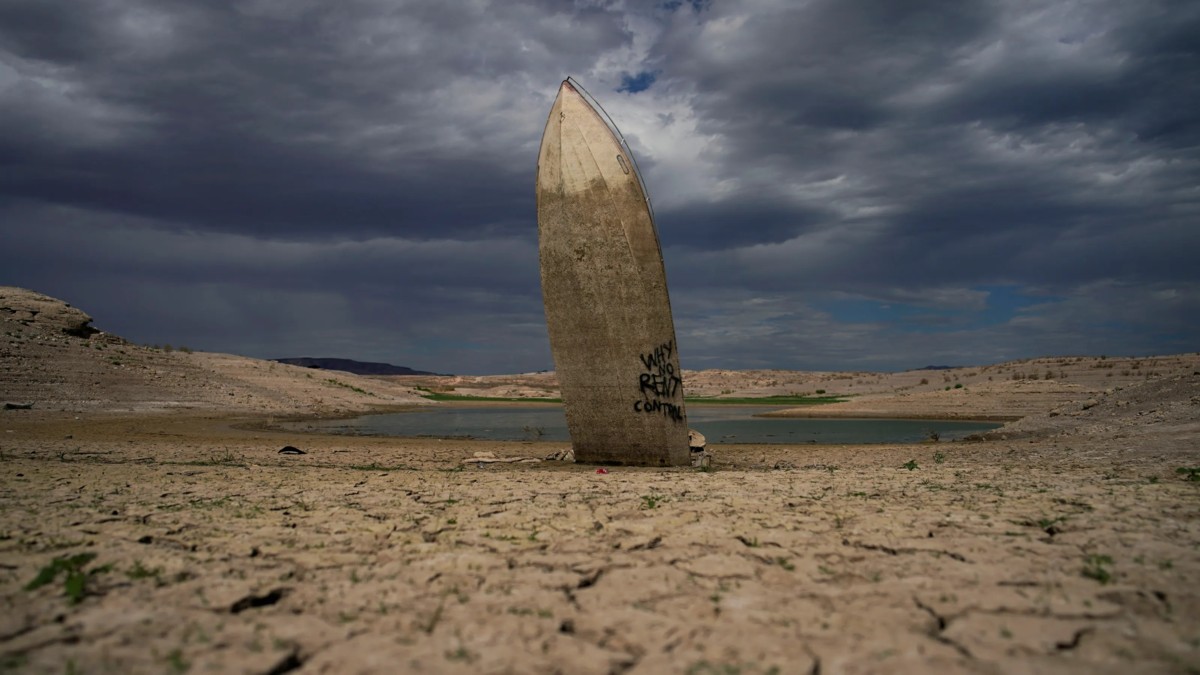
Despite recent rains, the water level in Lake Mead – which supplies Las Vegas with 90% of its water – was 1,046.94 feet above sea level on Feb. 2. That’s only 28% of its full capacity. And cutting water use, even drastically, may not solve the problem. Because of climate change, some estimates predict that the Colorado River may deliver only half its current amount of water by the year 2100.

Lake Mead
Lake Mead
A 22-year drought in the American Southwest is sinking Lake Mead to depths it hasn’t seen since it was filled nearly 100 years ago, exposing several long-submerged bodies boats. (Image: azcentral.com)

Pumping Mississippi River water into Lake Mead has been suggested before. But as water levels drop – threatening to eventually cut off California, Arizona and Mexico from their Colorado River water allotments – and as engineering technology advances, large-scale river diversion doesn’t seem as much of a pipe dream as it once did.

In 2021, the Arizona state legislature actually passed a measure urging Congress to investigate pumping flood water from the Mississippi to the Colorado to boost its flow. Studies show that a project like this would be possible, though it would take decades of construction and billions of dollars. Maybe even trillions.

“I think it would be foolhardy to dismiss it as not feasible,” Richard Rood, professor of Climate and Space Sciences and Engineering at the University of Michigan told the Cedar Rapids Gazette. “But we need to know a lot more about it than we currently do.”

Large-scale river diversion projects have been proposed in the US since the 1960s, when an American company sought to redistribute Alaskan water across the continent using canals and reservoirs. That plan never generated enough support – a fate shared by similar proposals in Minnesota and Iowa.

Still Too Pricey … For Now

In 2012, the U.S. Department of the Interior’s Bureau of Reclamation performed a Colorado River Basin analysis considering several solutions to the current drought – including importing water from the Missouri and Mississippi Rivers.

Under the analyzed scenario, water would be diverted to Colorado’s Front Range and areas of New Mexico. That would cost at least $1,700 per acre-feet of water, potentially yield 600,000 acre-feet of water per year by 2060, and take 30 years to construct.

A decade later, Roger Viadero, an environmental scientist and engineer at Western Illinois University, calculated that moving this scale of water would require a pipe 88 feet in diameter – twice as long as a semi trailer – or a 100-foot-wide channel that’s 61 feet deep.

“As an engineer, I can guarantee you that it is doable,” Viadero told the Cedar Rapids Gazette. “But there are tons of things that can be done but aren’t ever done.”

Viadero’s team estimated the cost of buying enough water to fill up the Colorado River’s Lake Mead and Lake Powell at more than $134 billion, assuming a penny per gallon. Add to that heavy construction costs and the costs of powering the equipment needed to pump the water over the Western Continental Divide. Buying the land to secure water rights would be very costly, too.

Politics: The Other Problem

The political hurdles are also considerable. They include wetlands protections, endangered species protections, drinking water supply considerations, and interstate shipping protections. Precedents set by other diversion attempts – such as the ones that created the Great Lakes Compact, also cast doubt over the political viability of any large-scale Mississippi River diversion attempt.

And trans-national pipelines would also impact ecological resources. Lower Mississippi River flow means less sediment carried down to Louisiana, where it’s needed for coastal restoration. Diverting that water also means spreading problems, like pollutants, excessive nutrients, and invasive species such as Asian carp.

None of this even considers the most important question: Is there even enough water to spare? The Mississippi River basin may no longer even be a reliable answer to the Colorado River basin’s problem, since the Mississippi is drying up, too. Water levels are at or below the low-water threshold along a nearly 400-mile stretch of the river. This past year, sunken boats, such as the Diamond Lady riverboat casino, are surfacing like bodies are in Lake Mead.

“No one wants to leave the western states without water,” Melissa Scanlan, a freshwater sciences professor at the University of Wisconsin-Milwaukee, told the Cedar Rapids Gazette. “But moving water from one drought-impacted area to another is not a solution.”

Growing Precedent

Still, there is hope. Last year, a Kansas groundwater management agency received a permit to truck 6,000 gallons of Missouri River water into Kansas and Colorado to recharge an aquifer. Several approved diversions already drain water from the Great Lakes. And in northwestern Iowa, a river has repeatedly been pumped dry by a rural water utility that sells at least a quarter of the water outside the state. And there

In July 2022, former Arizona Gov. Doug Ducey signed legislation investing $1.2 billion into projects that conserve water and bring more into the state. Among its provisions, the law granted Arizona’s water infrastructure finance authority to “investigate the feasibility” of potential out-of-state water import agreements.

And, as the tired adage goes, desperate times call for desperate measures. According to a two-year projection by the federal Bureau of Reclamation, by the end of July 2024, Lake Mead’s water level could fall to as low as 992 feet above sea level. That’s perilously close to dead pool (895 feet), the point when a reservoir is so low, gravity will no longer allow it to release water downstream. If and when Lake Mead hits this point, that will be dire news for downstream regions, including Los Angeles, Phoenix, San Diego, Tucson, and Mexico.

“It’s possible that the situation gets so dire that there is an amount of money out there that could overcome all of these obstacles,” Rhett Larson, an Arizona State University professor of water law, told the Cedar Rapids Gazette. “It might be in the trillions, but it probably does exist.”

In the meantime, researchers encourage more feasible and sustainable options, such as better water conservation, water recycling, and less agricultural reliance.

The post Filling Lake Mead with Mississippi River Water No Longer a Pipe Dream appeared first on Casino.org.