Las Vegas Strip Attraction Closing After Only 7 Months

The Las Vegas Strip just got a little less immersive. “Particle Ink: House of Shattered Prisms” will close on Monday, Oct. 28, after only seven months at the Luxor.

This promotional image was distributed when “Particle Ink: House of Shattered Prisms” opened at the Luxor in April. (Image: MGM Resorts)

Occupying the former wedding chapel on the casino resort’s mezzanine level, “Particle Ink” bills itself as an experience “merging the worlds of art and technology with immersive virtual and augmented reality.” It was created by an art collective called LightPoets and executive-produced by Minneapolis-based entertainment technology company Kaleidoco.

“We are immensely grateful to the Las Vegas community for embracing Particle Ink and allowing us to grow within this incredible city,” Jennifer Tuft, founder of Kaleidoco, said in a statement. “We’ve been honored to share this journey with everyone who has supported us and believed in our vision.”

House of Shuttered Prisms

No reason was provided for the closure. However, there is a rule covering 99.99% of the closures of shows, restaurants, nightclubs and other attractions on the Strip. And that rule is that nothing ever comes to an end here unless it fails to draw enough paying customers to cover the exorbitant cost of modern Strip leases.

In the case of “Particle Ink,” it was a partnership with Luxor/MGM Resorts, which means that the decision to close was probably not their own.

When it opened in April, “Particle Ink” was seen by industry observers as MGM Resorts’ attempt to lure Gen Z — which visits Las Vegas by the millions every year primarily to patronize AREA15 — to the Strip as well.

AREA15 is an entertainment complex located in a series of warehouses northwest of the Strip. Its tenants — anchored by “Omega Mart” from Minneapolis’ Meow Wolf art collective — marry art, technology and commerce so successfully, the City of Las Vegas recently dedicated America’s first “immersive tourism district”  around it.

“Particle Ink” was probably better off waiting for a slot in this district than taking the gamble it did. In the attraction’s previous Las Vegas incarnation — as an independent production called “Speed of Light” staged in a downtown warehouse — it drew sellout crowds and critical raves.

At the Luxor, Particle Ink presents itself in two editions: a daytime walk through trippy projected images called Wanderlust ($27) and a nighttime version that involves live performers, acrobatics and whatever “the deepest secrets of the 2.5th dimension” are supposed to be.

For tickets to its final performances, click here.


The post Las Vegas Strip Attraction Closing After Only 7 Months appeared first on Casino.org.
Slots a Fun (Re)Introduces Coin Slots to Vegas Strip

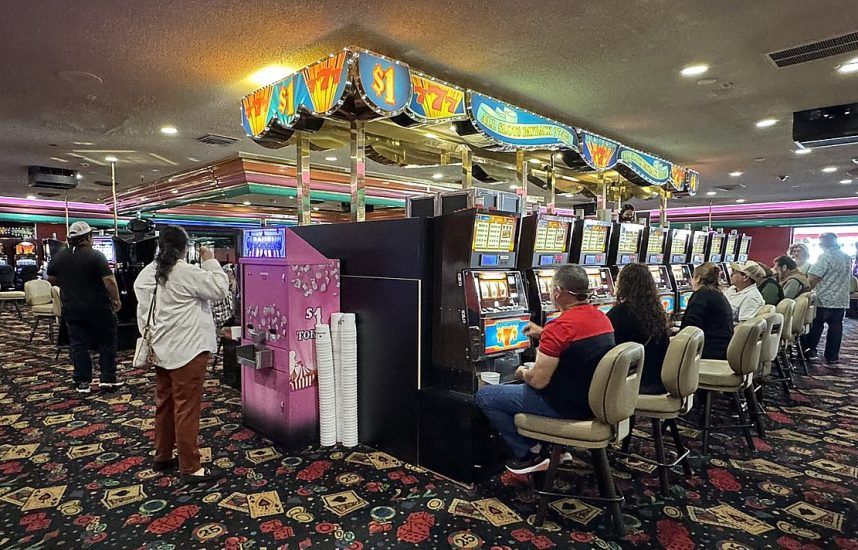
Circus Circus updated its Slots a Fun floor on Friday. Or, more accurately, they downdated it.

The newly gathered coin-operated slots at Slots a Fun boast actual reels, not virtual ones. (Image: X/@casinocollective)

The separate casino area, located next to Circus Circus’ main building, now features 85 coin-operated slot machines, many from the last millennium. (Technically, the mix of 25 cents, $1 and $5 machines are operated by tokens that need to be purchased.)

Ticket Out of Here

Coin slots began disappearing from casino floors across the US by the mid-2000s, as Ticket In Ticket Out (TITO) vouchers replaced almost all of them.

For casinos, TITO machines — developed in 1992 by MGM Corporation — eliminated the labor-intensive cost of having to continually empty hoppers of coins. Because of reduced cash handling, they also streamlined accounting procedures.

Paper money and vouchers also put less wear and tear on machines than coins do.

The problem with the newer machines, however, is that lots of gamblers miss the feel of coin slots and the big plastic barrels that got heavier when coin avalanches kerplunked into them.

This is why TITO machine manufacturers still replicate the sound of change dropping into the payout tray during jackpots.

Tokens of Their Appreciation

A Circus Circus press release describes this as a “strategic shift” that “reaffirms its dedication to honoring the essence of vintage Vegas while embracing innovation for the modern-day guest.”

In reality, there was no “American Pickers” rummage through junkyards or estate sales for retired machines. Circus Circus and its Slots a Fun were simply the last bastions of the Strip that modernization hadn’t completely transformed. So Phil Ruffin’s casino decided to flip this from a negative to a positive.

Around 50 of these last clattering icons — until recently found in smatterings across the Circus Circus and Slots a Fun floors — were simply gathered together into one place. Circus Circus then fortified the collection with 35 more token slots it purchased from vendors in Las Vegas and Iowa.

If the coin machines aren’t enough of a time portal to entice a visit curing your next Strip sojourn, Slots a Fun also features $2 beers, hot dogs, and shrimp cocktails. And 20 table games have been reintroduced into  its 8,000 feet of gaming space — all with $5 minimums.

What year is this again?

The post Slots a Fun (Re)Introduces Coin Slots to Vegas Strip appeared first on Casino.org.

Stakeholder Numbers Gelling for US$1.5 Billion A’s Stadium at Tropicana on LV Strip – 1/4 Public

stakeholder_numbers_gelling_for_usdlr1_5_billion_as_stadium_at_tropicana_on_lv_strip_1_4_publicThe Nevada Independent reported on Friday that a bill was to be introduced that day into the state Senate outlining the amount of state funding lawmakers were willing to tentatively commit to funding a new stadium for the Oakland A’s MLB baseball team on land provided by Ballys’ Tropicana Las Vegas. The nine-acre plot is part of 35 acres owned by GLPI and leased for 99 years by Bally’s. The proposed stadium and entertainment site sits on a contiguous plot of land along with the casino resort hotel.

A financing package, capped at $380 million in public funds was proposed later that day in the bill with those funds contributing to the overall expected cost of the project being $1.5B.

Governor’s Office Introduced the Measure

According to updates and later reporting by the news source, a good portion of the previously announced funding structure carried over from discussions to the written proposed legislation. The draft, seen by reporters there prior to being introduced at the capitol was the first glimpse in writing of the scope of a potential financing agreement that includes $120m from Clark County (where Paradise, Nevada “The Strip” is located), and $180m in tax credits (transferable) by the state.

The Governor’s office itself introduced Senate Bill SB509 which foresees the management of a Stadium Authority undertaken by a 9-member board. The Stadium Authority itself has been authorized since 2016 and the venue it oversees and manages would reportedly be named Allegient Stadium.

Since no new revenue-based funding would be needed, only transferable tax credits, a simple majority vote in both houses of Congress, and a signature by Governor Joe Lombardo who has been in office since January of this year is all that is needed for the measure to become law. A more detailed look at the tax credits shows them to consist of tax-increment financing (TIF district) to repay county bonds and a 30-year-long exemption from taxes. GLPI/Bally’s would allow the use of the property for zero fees and create their own revenue from it by means other than rent or lease costs to the Stadium Authority or ball club.

The ball club itself would be responsible for any over-runs in costs, rather than the county or state, and the property tax exemption would be separate from the private portion of the funding needed to bring the project to fruition.

Adding to the public good and mitigating any potential unseen impacts of the deal, the measure would require the county to create a “resort corridor homelessness prevention and assistance fund”. There would be no financial input from the Authority of the project until construction is completed and then only after debt obligations are met. It would be managed by a partnership with the Nevada Resort Association and the Oakland A’s and will seek to reduce homelessness throughout the Southern Nevada resort corridor.

The corridor, which includes the Las Vegas and Reno areas, has a higher homeless rate than the national average with the Reno area suffering the greatest incidence count between the two. However, it has recently been estimated that as many as 1,500 people live “like moles” beneath the Strip area in tunnels mostly to escape the heat.

Unhoused Population Would Get Help from Funding Scheme

Stated reasons for the higher homeless rate include inflation, high rent, and unemployment. Direct studies of problem gambling and homelessness by causation are few and far between. While the number of homeless people in Nevada could be 3x as many as the national average it’s unclear how baseball or expanded gambling at Bally’s Tropicana Las Vegas would contribute to the problem so the fund should probably be seen simply as a way for lawmakers to capture a financial opportunity to address a very real need in the area with “found money” rather than a mitigation measure.

Earlier, the athletic club had sought $500m in public funding to relocate to a new stadium in Las Vegas but abandoned that plan when the Bally’s opportunity presented itself to them, saving the public some $120m over the previous “ask”.

The Oakland A’s AAA Farm Team, the Las Vegas Aviators of the Minor league have been in the valley as Oakland affiliates since 2019 with the club’s origins in the valley going back to 1983 as the Aviators and under other names, affiliations, and locations since 1919. The Oakland A’s have been seeking a move from California to Las Vegas since at least September 2021 amid trouble securing a new stadium in Oakland. The current arena was first opened in 1966 and last renovated in 2017 after only one other refurbishment in 1995-1996.

The Independent reports that all is not a smooth slide to home base with the deal as the Republican governor and Democratic lawmakers are struggling to address overall budget issues with less than two weeks left in the regular legislative session. Senate leaders and the governor have seemingly used stadium approval as a bargaining chip to get their way. It’s not out of the question for a special legislative session to be called to extend lawmaking business, but it’s unclear if the stadium proposal would survive such a measure or if the governor might try to use his veto power on individual segments of the state’s budget in an attempt to exert power of the Democratic lawmakers or simply keep the government running.

Fast Tracking of Bill Possible

However, special legislative rules do allow for the fast-tracking of certain bills, bypassing the regular parliamentary (bureaucratic) process and allowing lawmakers to amend important measures much quicker than normal. As the measure was introduced in the Senate it would presumably be passed there, be forwarded to the House for approval, and then arrive on the Governor’s desk for his signature or veto.

Source: A’s stadium bill language arrives, caps public financing at $380M, The Nevada Independent, May 26, 2023

The post Stakeholder Numbers Gelling for US$1.5 Billion A’s Stadium at Tropicana on LV Strip – 1/4 Public appeared first on Casino News Daily.

Oakland A’s Eyeing Two Strip Sites for Las Vegas Move

Following another round of meetings between team officials and Las Vegas business leaders, it’s clear the Oakland Athletics are eyeing two sites on the Strip should the team move to Sin City — the fairgrounds owned by Circus Circus and the Tropicana.

A's Las Vegas
A's Las Vegas
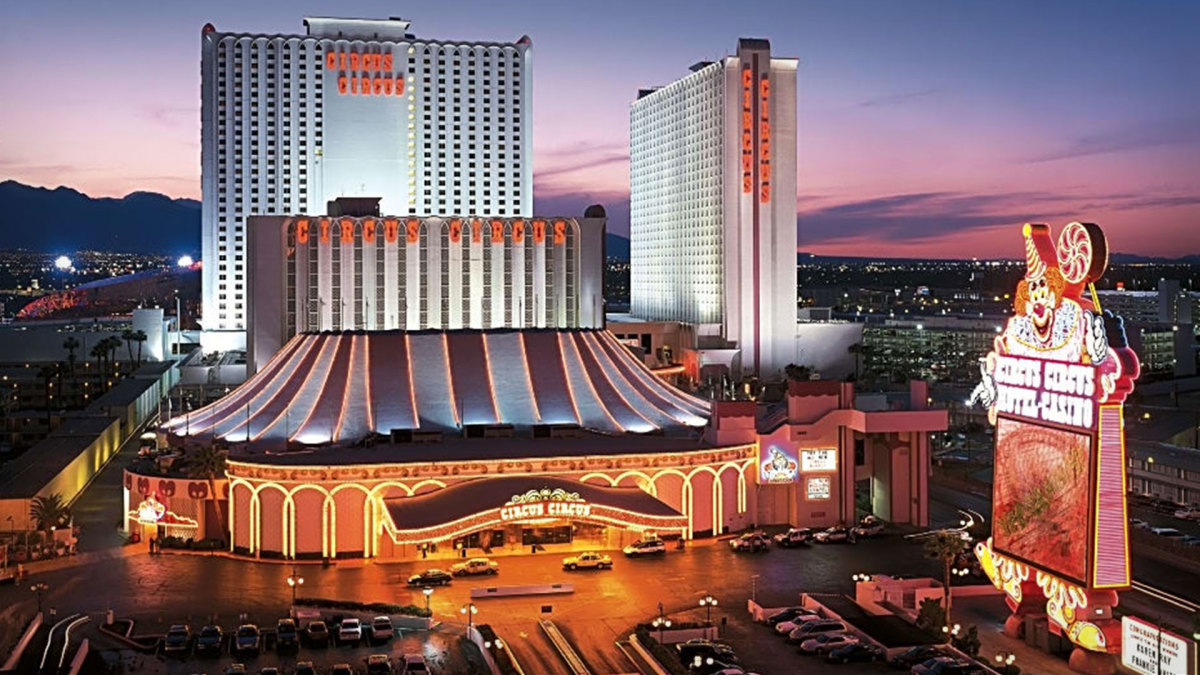
Circus Circus Las Vegas. It’s fairgrounds could be a stadium site for the Oakland A’s. (Image: TheStreet.com)

The Major League Baseball (MLB) club has long-rumored interest in Las Vegas and it originally had a list of 20 potential sites for a new, $1 billion stadium. But that roster, as was widely believed would happen, has been whittled to two. It’s clear that land owned by Wynn Resorts on the Strip is out of the running, as a company spokesperson told the Las Vegas Review-Journal it’s not interested in a ballpark being built on that property.

That leaves the 37-acre fairgrounds and recreational vehicle (RV) park near Circus Circus and the Tropicana, which have also been epicenters of long-running MLB stadium rumors, as the A’s preferred sites.

North Strip, Downtown Operators Support A’s Move

A’s officials were in Las Vegas yesterday meeting with executives from North Strip and downtown casinos. That group is supportive of the team’s efforts to move to Las Vegas, citing benefits such as job creation and increased visits to area casino-hotels.

At issue is the point that Circus Circus owner Phil Ruffin apparently didn’t participate in the meeting, nor did he comment to the press about any talks with the A’s. The last remarks he made on the issue were late last year, indicating he hadn’t recently been in touch with officials from the team. That’s relevant because Circus Circus is considered part of the North Strip.

Conversely, Tropicana is closer to the southern end of the Strip, and Bally’s executives have confirmed recent talks with the A’s. Last year, executives from Gaming and Leisure Properties — the owner of Tropicana’s real estate — said the A’s are interested in that site.

Should the team proceed with moving to Las Vegas and select Tropicana as a stadium site, Gaming and Leisure could sell the land to the franchise while providing compensation to Bally’s.

Other Issues Surrounding A’s Las Vegas Move

While the A’s appear set on the fairgrounds or Tropicana as a stadium site, and the team has approval from MLB to move, speculation remains that the ball club is simply using Las Vegas as leverage to force Oakland policymakers to sign off on a new stadium plan in the Bay Area. That theory isn’t a stretch when considering Oakland already lost the NFL’s Raiders to Las Vegas.

There are other moving parts. MLB Commissioner Rob Manfred agreed to waive the A’s relocation fee. But he and the team want some public financing for a Las Vegas stadium — something voters may be loathe to support.

Waiting on an expansion team could take years and be far more expensive than simply building a stadium for the A’s in Las Vegas. As Circa CEO Derek Stevens told the Review-Journal, an expansion franchise could cost up to $2 billion, and that doesn’t include the price of a new ballpark.

The post Oakland A’s Eyeing Two Strip Sites for Las Vegas Move appeared first on Casino.org.