Stakeholder Numbers Gelling for US$1.5 Billion A’s Stadium at Tropicana on LV Strip – 1/4 Public

stakeholder_numbers_gelling_for_usdlr1_5_billion_as_stadium_at_tropicana_on_lv_strip_1_4_publicThe Nevada Independent reported on Friday that a bill was to be introduced that day into the state Senate outlining the amount of state funding lawmakers were willing to tentatively commit to funding a new stadium for the Oakland A’s MLB baseball team on land provided by Ballys’ Tropicana Las Vegas. The nine-acre plot is part of 35 acres owned by GLPI and leased for 99 years by Bally’s. The proposed stadium and entertainment site sits on a contiguous plot of land along with the casino resort hotel.

A financing package, capped at $380 million in public funds was proposed later that day in the bill with those funds contributing to the overall expected cost of the project being $1.5B.

Governor’s Office Introduced the Measure

According to updates and later reporting by the news source, a good portion of the previously announced funding structure carried over from discussions to the written proposed legislation. The draft, seen by reporters there prior to being introduced at the capitol was the first glimpse in writing of the scope of a potential financing agreement that includes $120m from Clark County (where Paradise, Nevada “The Strip” is located), and $180m in tax credits (transferable) by the state.

The Governor’s office itself introduced Senate Bill SB509 which foresees the management of a Stadium Authority undertaken by a 9-member board. The Stadium Authority itself has been authorized since 2016 and the venue it oversees and manages would reportedly be named Allegient Stadium.

Since no new revenue-based funding would be needed, only transferable tax credits, a simple majority vote in both houses of Congress, and a signature by Governor Joe Lombardo who has been in office since January of this year is all that is needed for the measure to become law. A more detailed look at the tax credits shows them to consist of tax-increment financing (TIF district) to repay county bonds and a 30-year-long exemption from taxes. GLPI/Bally’s would allow the use of the property for zero fees and create their own revenue from it by means other than rent or lease costs to the Stadium Authority or ball club.

The ball club itself would be responsible for any over-runs in costs, rather than the county or state, and the property tax exemption would be separate from the private portion of the funding needed to bring the project to fruition.

Adding to the public good and mitigating any potential unseen impacts of the deal, the measure would require the county to create a “resort corridor homelessness prevention and assistance fund”. There would be no financial input from the Authority of the project until construction is completed and then only after debt obligations are met. It would be managed by a partnership with the Nevada Resort Association and the Oakland A’s and will seek to reduce homelessness throughout the Southern Nevada resort corridor.

The corridor, which includes the Las Vegas and Reno areas, has a higher homeless rate than the national average with the Reno area suffering the greatest incidence count between the two. However, it has recently been estimated that as many as 1,500 people live “like moles” beneath the Strip area in tunnels mostly to escape the heat.

Unhoused Population Would Get Help from Funding Scheme

Stated reasons for the higher homeless rate include inflation, high rent, and unemployment. Direct studies of problem gambling and homelessness by causation are few and far between. While the number of homeless people in Nevada could be 3x as many as the national average it’s unclear how baseball or expanded gambling at Bally’s Tropicana Las Vegas would contribute to the problem so the fund should probably be seen simply as a way for lawmakers to capture a financial opportunity to address a very real need in the area with “found money” rather than a mitigation measure.

Earlier, the athletic club had sought $500m in public funding to relocate to a new stadium in Las Vegas but abandoned that plan when the Bally’s opportunity presented itself to them, saving the public some $120m over the previous “ask”.

The Oakland A’s AAA Farm Team, the Las Vegas Aviators of the Minor league have been in the valley as Oakland affiliates since 2019 with the club’s origins in the valley going back to 1983 as the Aviators and under other names, affiliations, and locations since 1919. The Oakland A’s have been seeking a move from California to Las Vegas since at least September 2021 amid trouble securing a new stadium in Oakland. The current arena was first opened in 1966 and last renovated in 2017 after only one other refurbishment in 1995-1996.

The Independent reports that all is not a smooth slide to home base with the deal as the Republican governor and Democratic lawmakers are struggling to address overall budget issues with less than two weeks left in the regular legislative session. Senate leaders and the governor have seemingly used stadium approval as a bargaining chip to get their way. It’s not out of the question for a special legislative session to be called to extend lawmaking business, but it’s unclear if the stadium proposal would survive such a measure or if the governor might try to use his veto power on individual segments of the state’s budget in an attempt to exert power of the Democratic lawmakers or simply keep the government running.

Fast Tracking of Bill Possible

However, special legislative rules do allow for the fast-tracking of certain bills, bypassing the regular parliamentary (bureaucratic) process and allowing lawmakers to amend important measures much quicker than normal. As the measure was introduced in the Senate it would presumably be passed there, be forwarded to the House for approval, and then arrive on the Governor’s desk for his signature or veto.

Source: A’s stadium bill language arrives, caps public financing at $380M, The Nevada Independent, May 26, 2023

The post Stakeholder Numbers Gelling for US$1.5 Billion A’s Stadium at Tropicana on LV Strip – 1/4 Public appeared first on Casino News Daily.
Red Rock Sitting on Treasure Trove of Stadium Land, Says Analyst

Red Rock Resorts (NASDAQ: RRR) delivered first-quarter results on Thursday. But the company was mostly mum about a potential land sale to Major League Baseball’s Oakland Athletics. Analysts believe the casino operator can wring significant rewards from such a transaction.

Red Rock
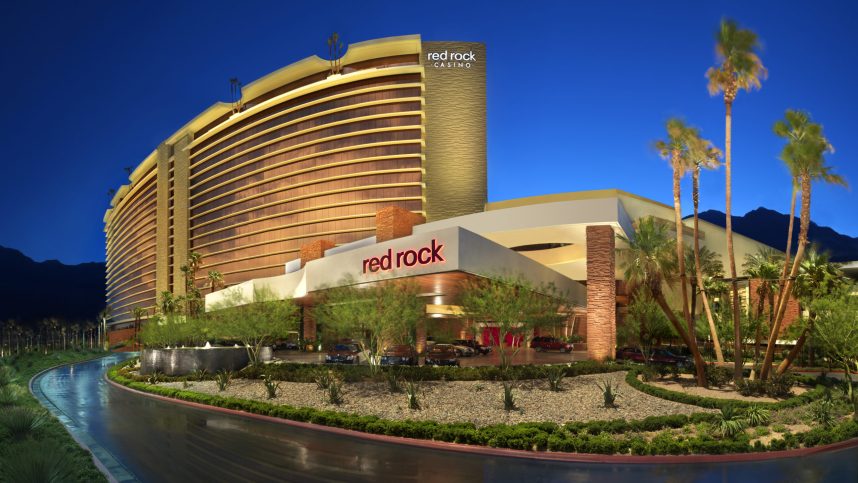
An image of the Red Rock Resort, Casino, and Spa. The operator could be in for a big payday in its baseball stadium land sale. (Image: Station Casinos)

Less than three weeks ago, it was revealed the A’s are moving to Las Vegas and plan to build a $1.5 billion ballpark near Tropicana Boulevard and Interstate 15. That land is owned by Red Rock. The operator previously wanted to use a portion of the 96 acres for its Viva casino complex, but the global financial crisis damned that effort. The A’s have an agreement with Red Rock under which the team will buy 48.6 of those acres, with an option to acquire eight more in the future.

Due to confidentiality, the purchase price of this transaction has not been disclosed, but the anticipated closing of the sales anticipated to occur in the fourth quarter later this year. As a reminder, the entire Viva site consists of 96 acres,” said Red Rock CFO Stephen Cootey on a conference call with analysts. “So if the A’s transaction closes and they exercise their 8-acre option, we still retain 39.3 acres for future monetization as we continue to execute on our strategy of repositioning our land portfolio for future growth.”

Twenty of those acres were previously occupied by Red Rock’s Wild Wild West Gambling Hall & Hotel, which the operator shuttered last September and later demolished.

Red Rock Primary Beneficiary of A’s Move

While it’s expected that all Las Vegas casino operators will benefit from adding Major League Baseball to Sin City, the consensus is building among analysts that gaming properties catering to locals will be the biggest winners, with Red Rock a clear leader of that group.

The land is an obvious foundation for that thesis, and while Red Rock isn’t yet telling analysts and investors how much it’s getting for the property it’s selling to the A’s, it will surely be an impressive sum.

“Even if they don’t build a casino, we believe the company’s remaining ~40 acres that would sit next to the ballpark complex would become extremely valuable if they wanted to eventually sell those acres,” wrote Stifel analyst Steven Wieczynski in a note to clients. “We estimate that land sold around the Raiders’ new stadium was valued in the $5M-$6M range, and believe RRR’s untapped acreage around the prospective A’s ballpark could go for more than that.”

Even when working on a hypothetical scenario that Las Vegas commercial real estate hasn’t appreciated over the past several years, Red Rock would gross $288 million by selling 48 acres to the A’s at $6 million an acre. Throw in the eight acres the A’s have the option to buy, and the potential sales price at $6 million balloons to $336 million, or a significant percentage of Red Rock’s market capitalization of $4.76 billion.

Land Sale Cash Added Perk for Red Rock

As Wieczynski pointed out, Red Rock already has one of the cleaner balance sheets among regional casino operators, indicating it doesn’t necessarily need the capital from the land sale. It’s merely icing on the cake.

We think this story becomes more attractive by the day and while we model flattish margins moving forward, if we are wrong, shares are massively undervalued at current levels,” concluded the analyst.

He rates the stock “hold” with a $54 price target.

The post Red Rock Sitting on Treasure Trove of Stadium Land, Says Analyst appeared first on Casino.org.

Las Vegas’ Allegiant Stadium Nearly Doubled 2022 Tourism Forecast

Nearly half of the 1.7M fans who packed sporting and music events at Allegiant Stadium in 2022 were tourists, according to a new report in the Las Vegas Review-Journal. That is nearly double the number that was originally forecast.

Allegiant Stadium Las Vegas
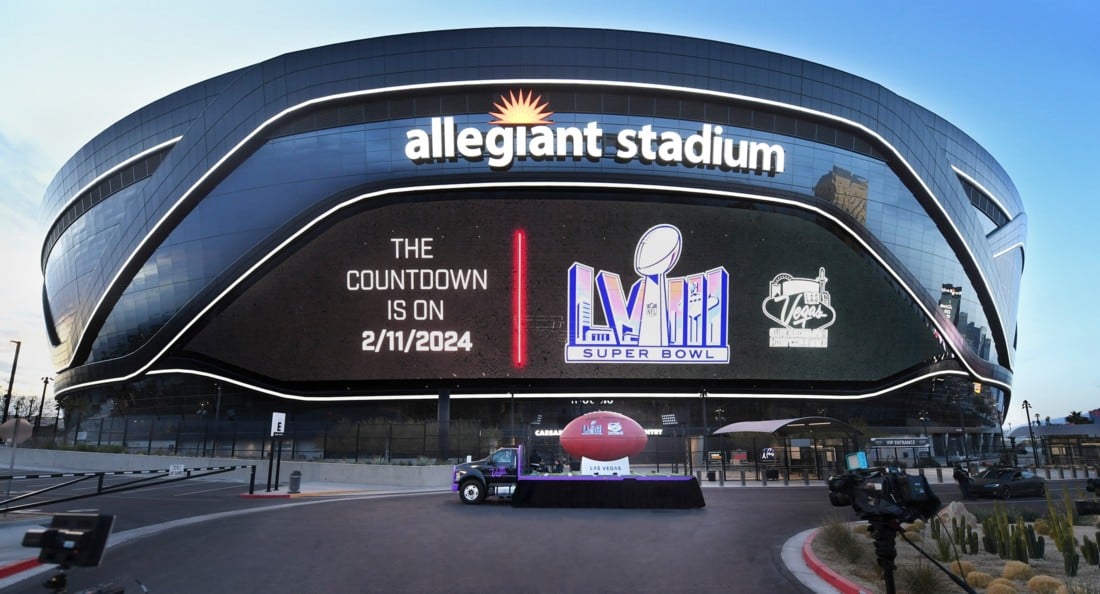
The top-attended Allegiant Stadium event in 2022 was the Las Vegas Raiders vs. Los Angeles Chargers NFL game on January 1. It drew 58,871 fans. (Image: Facebook)

Stadium Authority chair Steve Hill — who also serves as president and CEO of the Las Vegas Convention and Visitors Authority — told the newspaper that his organization had predicted that tourism would account for only 27% of an average Allegiant crowd. Instead, that number turned out to be somewhere between 40% and 49%.

About 65% of the approximately 500K fans who attended the last five Raider home games of last season (or 325K) came from out of town, according to the stadium authority, with a high of 69% (or 39.9K) coming for the December 18, 2022 matchup against the New England Patriots.

But the highest percentage of tourists was the whopping 87% (or 48,716 fans) in the stands for the October 8, 2022 one-off Shamrock Series football game between Notre Dame and BYU. According to the stadium authority, 81% of those fans traveled to Las Vegas specifically to attend that game.

In Your Face, Doubters!

This is great news for Las Vegas tourism, the kind winning converts of those who opposed the original plan to build Allegiant.

Constructed between 2017 and 2020 to bring the NFL’s Raiders over from Oakland, the stadium cost $1.9B. That makes it the second most expensive stadium ever built — after the Rams’ $5.5B SoFi Stadium in LA. The difference is that SoFi was 100% privately funded, while $750M of Allegiant’s price tag was footed by municipal bonds issued by Clark County. Those bonds were backed by the proceeds of a 1.4% special tax on Las Vegas hotel rooms — a tax that also partially funded an expansion of the Las Vegas Convention Center.

In 2016, two grassroots lobbying organizations fiercely opposed the public funding, noting that it came at a time when state budgets had been slashed by $300M to cover shortfalls. In a statement made at the time, Nevadans for the Common Good said the stadium deal “involves substantial risk to the public without providing commensurate community benefits.” A statement from the Nevada Taxpayers Association noted that there was “significant data indicating that subsidized stadiums can be a detriment to a community.”

News of Allegiant’s unexpectedly high 2022 contribution to Las Vegas tourism was  enough to get at least one former naysayer singing a new tune. In 2016, Tick Segerblom, now a Clark County Commissioner, was one of only five state senators who voted against Allegiant’s public funding.

“The truth is, I think it’s beat everybody’s wildest expectations,” Segerblom told the R-J. “It filled a void and now we can hold any event in the world. It really has been incredibly beneficial.”

The post Las Vegas’ Allegiant Stadium Nearly Doubled 2022 Tourism Forecast appeared first on Casino.org.