Vista Equity Reportedly Shopping Stats Perform

Private equity firm Vista Equity Partners is rumored to be shopping sports data provider Stats Perform.
Stats Perform
The Stats Perform logo. Parent company Vista Equity Partners is said to be looking for a buyer for the sports betting data provider. (Image: Business Wire)

Citing unidentified sources with knowledge of the matter, Bloomberg reported the news earlier Thursday. It’s not clear what Vista Equity’s timeline is for divesting Stats Perform nor were potential suitors or sales prices mentioned. The company uses artificial intelligence (AI) and other technologies to provide sports-related data to media and gaming companies, among other clients.

Our AI capabilities uniquely position us to drive our industry forward. We take the richest live data in sport, the deepest historical database and partnerships with the leading federations and feed them through our AI program to produce more outputs, enable personalised experiences, surface truly unique insights and connect fans to the content right for them,” according to the Stats Perform website.

Vista acquired Stats in 2014 from FOX Sports and the Associated Press. It was merged with Perform in 2019 after Texas-based Vista invested in DAZN. Through that deal, the buyer gained access to Opta, RunningBall and Watch&Bet.

Stats Perform Could Attract Multiple Suitors

With sports wagering increasingly data-dependent and technology-intensive, a variety of eager suitors could emerge for Stats Perform.

Some analysts view sports betting data providers as “picks and shovels” entities essential to sportsbook operators, particularly at a time of surging interest in live betting and single-game parlays (SGPs) among bettors.

The thesis largely revolves around the growth of the regulated global sports wagering market. It envisions sportsbook operators paying up for premium data, and the ability of these companies to adequately wring profits from league data accords. Stats Perform clients include Bet365, Google, La Liga and William Hill, among others, according to its website.

Competitors include Genius Sports (NYSE: GENI) and Sportradar (NASDAQ: SRAD), which have market values of $1.25 billion and $3.20 billion, respectively. It remains to be seen if that range provides some template for Stats Perform’s ultimate sale price.

Will this Time Be Different?

This isn’t the first time Vista Equity has shopped Stats Perform. Speculation that effect surfaced in mid-2021, but a transaction didn’t materialize.

Interestingly, those rumors surfaced just two months after rival Genius went public via a reverse merger with a special purpose acquisition company (SPAC) and just three months prior to Sportradar’s initial public offering (IPO).

Stats Perform is “led by Chief Executive Officer Carl Mergele, provides artificial-intelligence solutions and other data to betting platforms, technology companies as well as National Football League, National Basketball Association and Major League Baseball teams. It also provides insights on individual athlete and team performance in other sports including rugby, cricket, soccer, golf and tennis,” according to Bloomberg.

The post Vista Equity Reportedly Shopping Stats Perform appeared first on Casino.org.
LIV Golf Probe Sees US Senator Subpoena Saudi-Owned Firm

A U.S. senator is turning up the heat in his probe into the Saudi Arabian government’s involvement in professional golf and the proposed merger between LIV Golf and the PGA Tour.

Connecticut Senator Richard Blumenthal
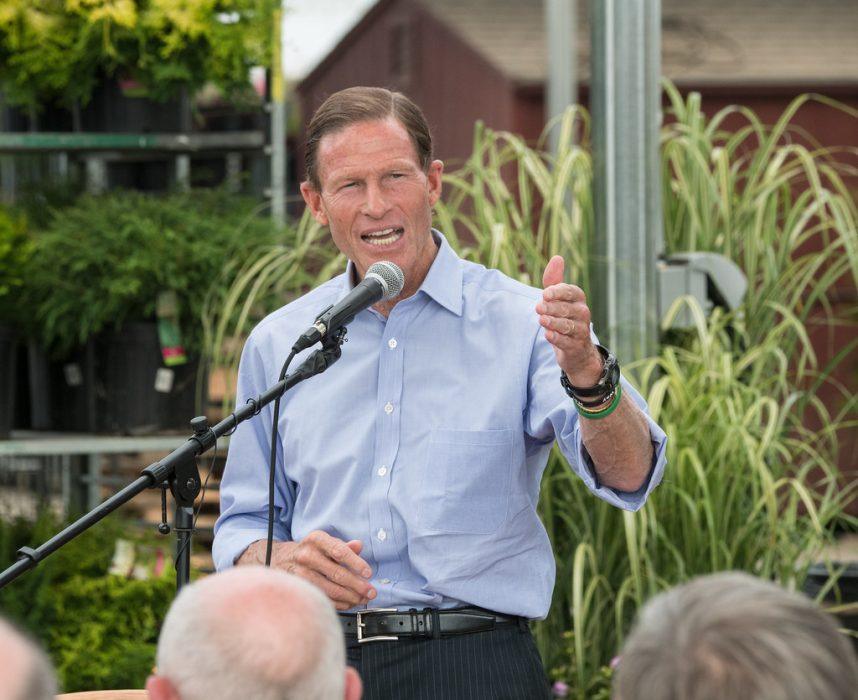
Connecticut Senator Richard Blumenthal is stepping up his investigation into the LIV Golf merger with the PGA Tour. Blumenthal has subpoenaed a U.S. subsidiary of the Saudi Arabian Public Investment Fund, which he alleges is not cooperating with his probe. (File photo by USDA via Creative Commons)

Sen. Richard Blumenthal — a Connecticut Democrat who chairs the Senate’s Permanent Subcommittee on Investigations — issued a subpoena Wednesday. His target is the U.S. subsidiary of the Saudi Arabian Public Investment Fund, which owns the upstart LIV Golf tour.

The subpoena comes as part of an ongoing investigation by the Connecticut Democrat into the Saudi government’s efforts to cover up its record of human rights abuses. The Saudis hope to improve their reputation by investing in U.S. institutions like the PGA Tour.

Saudi Investments Growing

In a memo outlining the basis for the subpoena, Blumenthal argues that the Saudi government is engaged in a multi-front campaign to increase its influence in the U.S. by acquiring key assets.

The Subcommittee’s inquiry thus far has demonstrated that PIF’s planned takeover of professional golf is part of a much larger planned expansion of its investments worldwide,” Blumenthal wrote.

Since 2015, the investment fund has seen its assets under management grow from $152 billion to $776 billion, and the Saudi government ultimately hopes to have that hit at least $2 trillion by 2030, according to the memo.

The PIF has invested in major U.S. companies, including Meta Platforms, JPMorgan Chase, and Uber, as well as prominent private equity firms, according to the memo. But Blumenthal argues there is a “lack of visibility” into how those investments may contribute to broader Saudi influence-peddling efforts.

‘Sportswashing’ Allegations

The fund could “use investment to suppress unfavorable narratives about Saudi Arabia,” Blumenthal warns, citing reports that Vice Media removed a documentary critical of Saudi Crown Prince Mohammed bin Salman after merging with a Saudi media company.

Blumenthal also warns that PIF investments can be used to “distract” from negative stories about Saudi Arabia.

PIF’s PGA Tour investment fits in this bucket because it appears to be a classic attempt at a practice known as ‘sportswashing,’” Blumenthal wrote.

The subpoena targets the PIF’s wholly-owned U.S. affiliate, USSA International LLC, and seeks documents related to the fund’s involvement with the PGA Tour and other U.S. investments. Blumenthal says the subpoena is necessary after PIF  and PIF and its governor, Yasir Al-Rumayyan, have refused to voluntarily cooperate with the subcommittee’s investigation over the past three months.

“The Saudi’s Public Investment Fund cannot have it both ways: if it wants to engage with the U.S. commercially, it must be subject to U.S. law & oversight,” Blumenthal wrote on social media Wednesday.

Betting Scrutiny 

The subpoena comes amid scrutiny of LIV by some gambling regulators around the U.S.

Massachusetts banned wagers on LIV events this summer soon after announcing its interest in the PGA.

Earlier this month, a Kentucky Horse Racing Commission member questioned whether the eye-popping sums LIV offered to some of its top golfers undermined the league’s competitive integrity. But regulators included the league in the commonwealth’s new betting catalog.

The post LIV Golf Probe Sees US Senator Subpoena Saudi-Owned Firm appeared first on Casino.org.
Tabcorp Set To Receive Massive Refund From Australia’s Tax Authority

Tabcorp, the large Australian gambling and racing operator, gambled on its tax obligations and beat the house. It fought the Australian Tax Office (ATO) over certain tax calculations and won, leading to a refund of around AUD83 million (US$53.2 million).

Tabcorp Marquee at the Birdcage
Tabcorp Marquee at the Birdcage. The gaming operator has won a battle with Australia’s tax authority. (Image: FabulousFemme.com)

Tabcorp announced the settlement via a filing with the Australian Securities Exchange (ASX) yesterday. It brings to a close a drawn-out fight the company had with the tax authority over payments it previously made.

The results come at a good time for Tabcorp. It recently received a fine of AUD1 million (US$638,600) from the Victorian Gambling and Casino Control Commission (VGCCC) for violating the regulator’s rules two years ago.

Tabcorp Scores Against the ATO

The ATO previously demanded Tabcorp pay certain tax amounts on its licenses and other provisions. The company paid the full amount, but launched a legal battle, as it felt the tax authority wasn’t calculating the tax obligations properly.

Possibly in an effort just to avoid a lengthy fight, the ATO agreed to work with Tabcorp, with the refund amounting to around 20% of what the company had paid. However, it brings closure and allows the ATO and Tabcorp to move forward with one less legal headache to worry about.

When the company files its annual financial health report in June of next year, it will reflect the reimbursement. It will also show a payment of about AUD37 million (US$23.7 million) that it will have to make to The Lottery Corporation. That comes from the demerger Tabcorp underwent last year.

As a result, according to the ASX announcement, Tabcorp will show a benefit next June of around AUD45 million (US$28.7 million). That same report will display a new arrangement on certain license fees as well, which the company said must be treated as “capital.” However, it added that this shouldn’t impact its overall results one way or another.

Australian Gaming Operators Face Changes

Australia’s entire gambling ecosystem is undergoing some changes, several of which could impact how operators are able to interact with consumers. If Tabcorp’s recent settlement with the ATO won’t impact its results, some of these definitely would if they come to life.

Adam Rytenskild, the company’s Managing Director and CEO, doesn’t believe a complete ban on inducements, as some legislators and anti-gambling pundits have recommended, would be a smart move. Although he recognizes and supports changes to how operators can advertise, blocking any type of offer that attracts wagers goes too far.

Rytenskild expressed his position in an interview he conducted with Racenet, a news platform about horse racing in Australia. He was responding to a question about a recent parliamentary inquiry on online gambling, where the topic of a complete ban on inducements surfaced.

If the ban were to come into effect, a process that could take up to three years to complete, it could harm the regulated gambling market. The initiative would prevent the advertisement of inducements from regulated platforms, but wouldn’t be able to stop those from offshore operators on many websites.

Rytenskild, as well as others in the industry, has suggested a compromise – allow inducements, but not in advertising. While not a perfect solution, it’s one that would still benefit, not harm, the regulated market.

The post Tabcorp Set To Receive Massive Refund From Australia’s Tax Authority appeared first on Casino.org.

MGM Resorts CEO Bill Hornbuckle Traveling to Japan to Sign Final Development Docs

MGM Resorts CEO Bill Hornbuckle says he’ll travel to Japan later this month to sign the final two remaining development agreements relating to the company’s $9.3 billion integrated casino resort project in Osaka.

MGM Resorts Bill Hornbuckle Japan casino
MGM Resorts International CEO Bill Hornbuckle will travel to Japan later this month to sign the final two development agreements relating to the company’s MGM Osaka project. The multibillion-dollar casino will be built on Osaka’s Yumeshima Island. (Image: Akihabara News)

MGM is part of a consortium with Japanese financial services conglomerate Orix Corporation to bring Japan its first casino. The company in April 2022 secured Japan’s first casino license after pitching the central government an integrated resort plan for Yumeshima, an artificial island in Osaka Bay.

MGM and Orix will each control 42.5% of the destination, with the remaining 15% stake held by other financial backers, including Panasonic, Kansai Electric, and West Japan Railway.

Speaking last week at the 2023 Bank of America Gaming and Lodging Conference, Hornbuckle discussed the MGM Osaka project and its repeated delays and redesigns. Hornbuckle says MGM is finally readying to break ground on the IR that will take several years to construct.

“We have spent an extensive amount of time rescoping the project,” Hornbuckle said at the conference. “It’s been a journey.”

MGM has been fixated on Japan for nearly a decade. Former MGM CEO Jim Murren prophesied in 2014 that MGM would open Japan’s “first integrated resort” in Osaka.

Japan’s National Diet legalized up to three commercial casino resorts in 2018. Only MGM Osaka has been licensed to date.   

Final Contracts

Hornbuckle says he will soon travel to Japan where he’ll sign the project’s final two development agreements. One is for a lease of the property and the other is an implementation agreement that will allow work to begin on the resort.

I’m supposed to get on an airplane on September 29 and go to Japan to sign the final two agreements,” Hornbuckle said. “That means we can start in earnest, and to the extent we are able to do that, this will open in 2030.”

Global inflation has ballooned the MGM Osaka price tag by more than $1 billion. But Hornbuckle says the yen depreciating has played into the Las Vegas-based gaming operator’s hand.

The yen’s value against the US dollar has tumbled considerably since the COVID-19 pandemic. The yen’s purchasing power against the US dollar is down more than 25% since November 2020. As of this week, a US dollar is worth about 146 Japanese yen.

MGM officials have often referred to MGM Osaka as a $10 billion project, which could be a more appropriate budget should the yen recover.

The yen is trading at 145 or 147, some silly number right now,” Hornbuckle explained.

The MGM boss isn’t overly worried about the massive spending requirement to bring Japan’s first casino to reality. Hornbuckle cited Japan’s population numbering more than 100 million, including 19 million people in Osaka, as warranting the company’s ongoing financial commitment.

Engineering Marvel

Building a sprawling integrated resort and casino complex on an artificial island is no simple feat. Hornbuckle says the site, which spans more than 100 acres, will soon be ready for construction to break ground.

The MGM chief executive detailed that the casino resort’s frame will go down some 230 feet to reach bedrock. Hornbuckle says the drilling and cementing of the structure’s foundation will likely endure through 2024.

Come early 2025, Hornbuckle hopes, “you’ll begin to see hard construction going up.” MGM is targeting 2030 to welcome its first guests to MGM Osaka.

The post MGM Resorts CEO Bill Hornbuckle Traveling to Japan to Sign Final Development Docs appeared first on Casino.org.

LOST VEGAS: The Las Vegas Park Racetrack

Las Vegas Park opened 70 years ago this week. And you can easily be forgiven for never having heard of the one-mile horse track that was located on the site of today’s Las Vegas Country Club and Westgate Hotel.

That’s because it operated for a total of 13 days.

Las Vegas Park
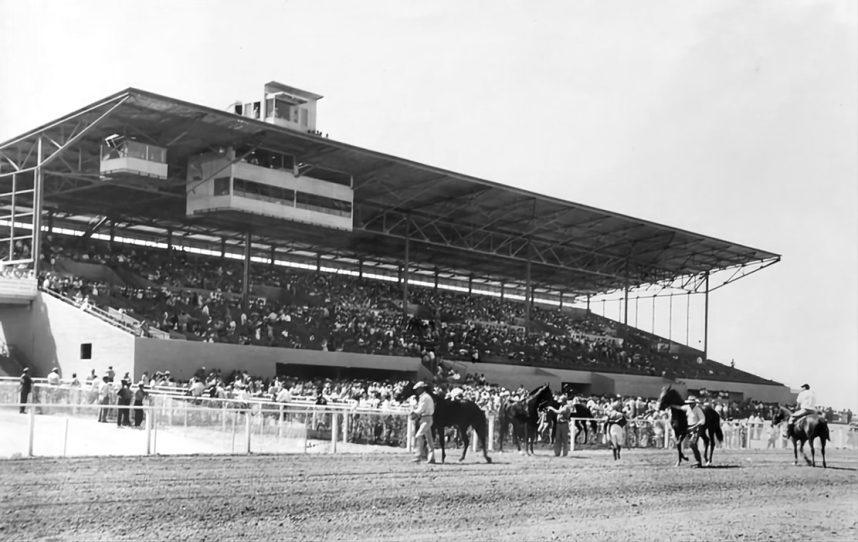
Opening day of Las Vegas Park, Sept. 4, 1953. (Image: Keeneland Library Thoroughbred Times Collection)

Las Vegas Park opened with giant aspirations on Sept. 4, 1953 for a 67-day inaugural meet. Its failure to meet those aspirations, or even to complete that schedule, is legendary.

It Seemed Like a Good Bet

Las Vegas Park
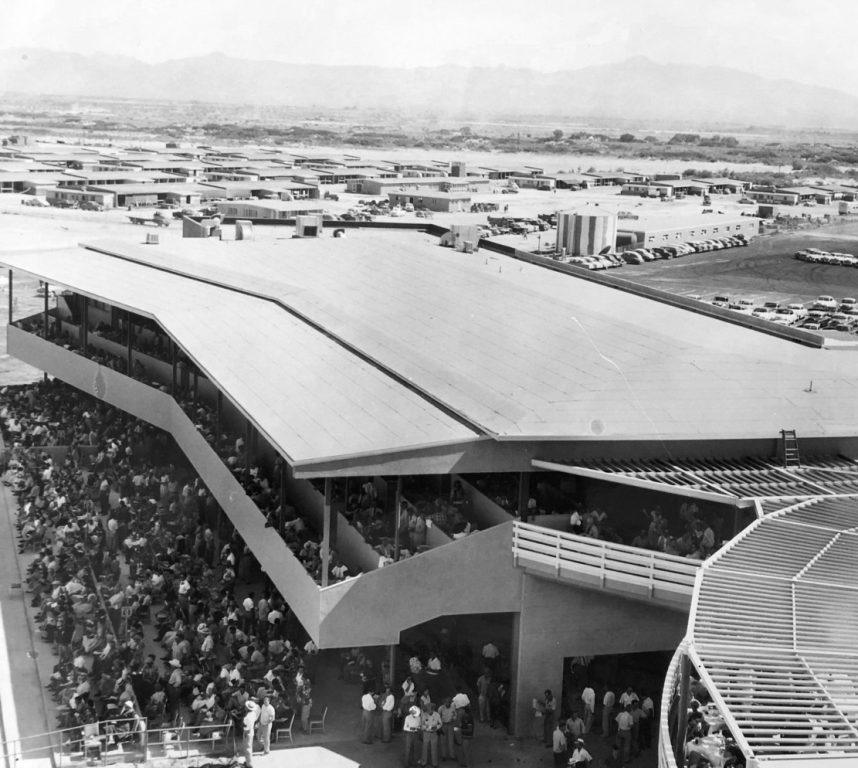
The clubhouse and turf club on one of the few race days at Las Vegas Park in 1953. (Image: Keeneland Library Thoroughbred Times Collection)

Las Vegas’ birth as an entertainment and gambling mecca dovetailed perfectly with the ‘50s boom in Thoroughbred racing. In fact, Las Vegas Park even made history as America’s first racino. (The Las Vegas Gaming Commission permitted 165 slots at the racetrack.)

It was gorgeous for its day, too. The clubhouse and grandstand were painted pink to replicate Argentina’s Hipodromo Rosado. Virtually no expense was spared in its $4.5 million budget (more than $40 million today).

And its schedule fit neatly in between the end of the Del Mar race meeting and the start of the Hollywood Park meeting.

This track seemed like a sure bet to host one of the premier Kentucky Derby prep races.

So how did something so perfect stumble out of the gate?

Major Blinders

Before the track ever opened, it already had a backstory tainted by corruption, embezzlement, and major blinders.

Las Vegas Park
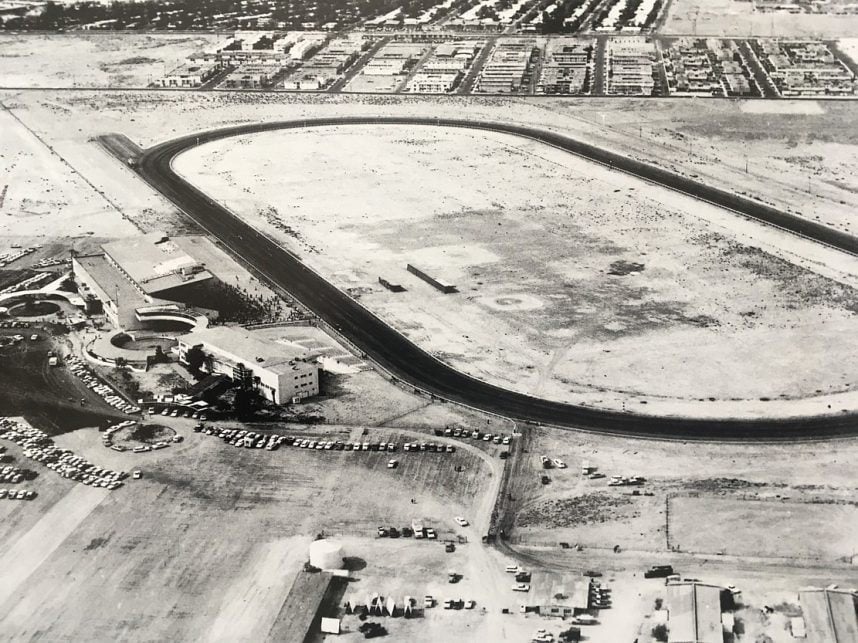
An aerial view of Las Vegas Park shows Sahara and Karen avenues at the top. (Image: Vintage Las Vegas)

That backstory began with Joseph M. Smoot — a New York racing promoter who had an early hand in the success of the Santa Anita and Hialeah racetracks, and figured that meant he could do anything.

In 1948, Smoot purchased 750 acres of vacant land just east of the Strip from the Leigh Hunt estate, at $750 per acre, and began constructing his dream a year later.

But a little more than a year after that, Smoot woke up in a nightmare. He was charged with three counts of embezzling $24K from the Las Vegas Thoroughbred Racing Association, over which he presided. During a hearing, a federal court judge  reportedly asked Smoot to produce receipts or canceled checks for $500K that reportedly went missing without a trace.

Smoot responded: “You ever try to pay a politician with a check?”

Smoot remained under indictment until he died of natural causes in 1955, penniless, in a free room at the Grand Hotel.

Second Race

By 1953, Las Vegas Park was bought out of its first bankruptcy and completed by the Las Vegas Jockey Club, a new corporation headed by investors including Lou Smith and Al Luke. Counting on a ton of big-name horses, and their big-spending Southern California owners, the partners promised to award $1.9 million — the richest prize ever offered by a first-year track.

To take their bets, they opened the very first $500 betting window at a horse track.

Las Vegas Park
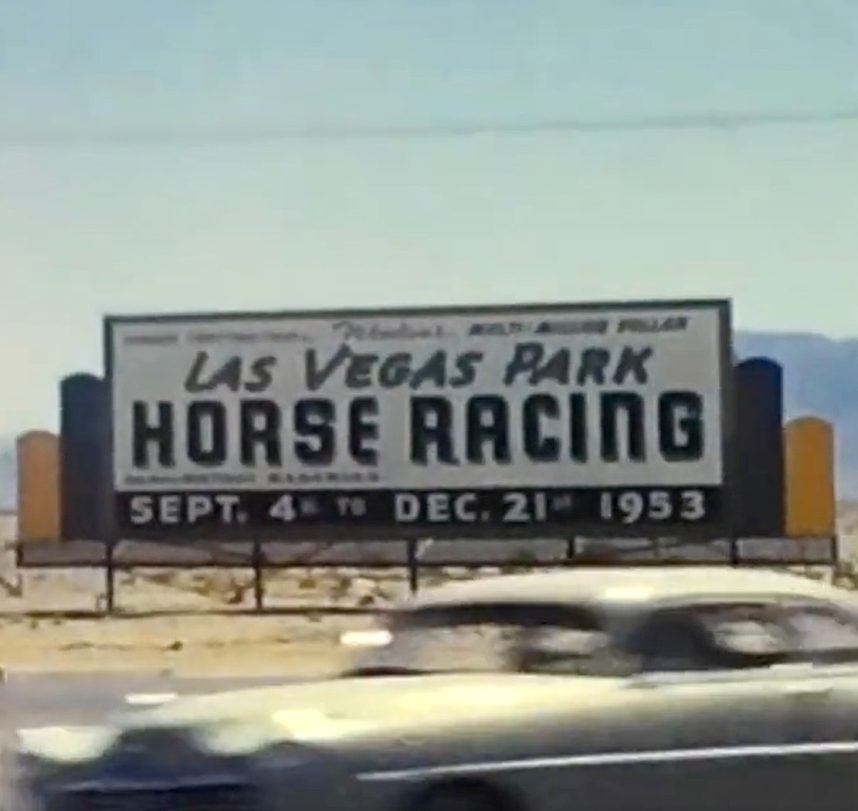
The sign for Las Vegas Park advertises a meet from Sept. 4 through Dec. 21, 1953 that ended two months early. (Image: YouTube/Ryan Lee Price)

When Las Vegas Park finally opened that Sept. 4, some of the horses came. (Among the 75 that ran was 15-time stakes winner Blue Reading.) But the big spenders were mostly AWOL. A devastating take of $252,683 fell nearly $150K short of the $400K daily requirement for the racetrack to meet expenses.

And the local population couldn’t  fill the void left by absentee tourists. Clark County had only 50,000 residents back then, compared to nearly 3.3 million today. In all, 8,200 paying customers occupied a space designed to hold 20,000.

Malfunctioning ticket booths, only one entrance that worked, and a major malfunction of the infield tote board didn’t help matters. After its third day open, the track closed for two weeks while a replacement board was installed, erasing what little momentum and word-of-mouth opening day generated.

After Las Vegas Park reopened, it didn’t log a single break-even day . When 4,000 customers wagered a total of $100K on Oct. 10, veteran racing journalist Pete Bonamy called it “one of the poorest showings by a racing crowd ever recorded.”

Las Vegas Park closed on Oct. 19, 1953, after racing only 13 programs.

“Racing needs population,” columnist Leon Rasmussen wrote in Thoroughbred Record magazine at the time, “and although Las Vegas does not hew to convention in very many ways, it is still not quite fabulous enough to sustain a track as pretentious as this one hoped to be.”

Beating a Dead Horse Track

Its stables were vacated in October 1953, though the complex was revived for another short but failed horseracing run the next year. The daily attendance recorded by the Las Vegas Turf Club in December 1954 was even more dismal than its predecessor — at times as low as 400. That experiment lasted seven weeks.

Las Vegas Park
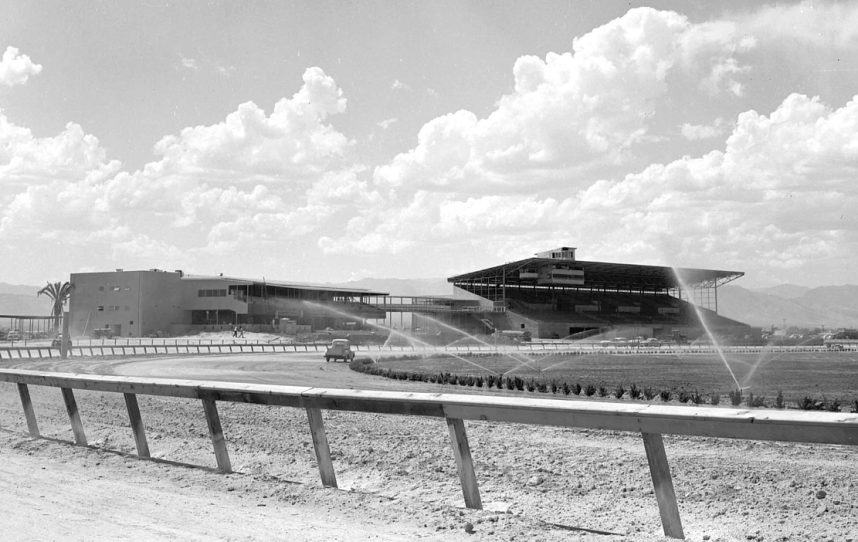
Las Vegas Park during its construction in 1951. The turf course, shown being watered, would have been the first used for racing the western US, but it was never used. (Image: Las Vegas News Bureau)

By January 1955, an oil magnate bought the racetrack out of its second bankruptcy for $2.65 million. But Joe W. Brown didn’t intend to build a third failed horseracing track. His thing was purchasing properties to hold onto them for others. Two years earlier, he purchased the Horseshoe Club from his old Texas buddy, Benny Binion, so he could run it while Binion served four years in Leavenworth Penitentiary for tax evasion.

And Brown purchased Las Vegas Park for a similar reason. He was holding onto it while the City of Las Vegas got its ducks in a row. The city wanted a portion of the land to build what eventually became the Las Vegas Convention Center, but didn’t have the funding at the time.

By January 1956, that deal was complete and the first convention hall — a 6,300 capacity, silver-domed rotunda with an adjoining 90,000 square-foot exhibition hall — opened following Brown’s death three years later. On Aug. 20, 1964, it hosted the only Beatles concert in Las Vegas.

Vroom For Rent

While it awaited demolition, the mostly intact and renamed Las Vegas Park Speedway was repurposed for auto racing. It hosted three major races: the AAA Champ Car event in 1954, the NASCAR Grand National Championship in 1955, and a United States Auto Club Grand Prix in 1959.

In 1965, Brown’s estate sold most of its remaining acreage to National Equities Inc., which used it to construct the Las Vegas Country Club — along Joe. W. Brown Drive.

National Equities sold a leftover parcel to hotel magnate Kirk Kerkorian to build the International Hotel. An extra 20 acres was sold to Clark County to expand the Convention Center. And the southeast corner became the site of the Regency Tower, Las Vegas’ first residential high-rise.

Las Vegas Park was finally demolished in 1966.

“Lost Vegas” is an occasional Casino.org series featuring remembrances of Las Vegas’ lesser-known history. Click here to read other entries in the series. Think you know a good Vegas story lost to history? Email corey@casino.org.

The post LOST VEGAS: The Las Vegas Park Racetrack appeared first on Casino.org.