Illinois Township Supervisor Admits Using Government Funds at Casino, Won’t Resign

A township supervisor in Illinois is refusing to resign from her position despite admitting to using government money at a casino.

Illinois township casino Horseshoe St. Louis
Canteen Township Supervisor Sally Rodriguez has admitted to using government money for her personal use. Despite the admissions, the Illinois township supervisor is refusing to resign. (Image: Casino.org)

During the Canteen Township Board of Trustees’ September 4 meeting, Township Supervisor Sally Rodriguez admitted to using the town’s debit card for her personal use. But Rodriguez, who was appointed to her position in May of 2023 by the trustees, claims the debit withdrawals on the government card were made by mistake.

Trustees say an anonymous source tipped them off that Rodriguez didn’t only poach money from the township via debit card, but also wrote herself checks from the township’s bank account that she cashed. Banking records show six transactions were completed at the Horseshoe Casino St. Louis that’s operated by Caesars Entertainment.

Rodriguez confessed to withdrawing $6,000 in cash at the casino. She also cashed two checks made out to herself from the township checking account, and a third directly made out to cash.

Canteen Township is located in St. Clair County in southwestern Illinois along the Mississippi River. The township includes Caseyville, Fairmont City, Fairview Heights, Madison, and Washington Park. Horseshoe Casino St. Louis is just across the river from the township.

The Belleville News-Democrat first broke the news of Rodriguez’s actions.

Resignation Refusal

During the September meeting, Canteen Township Trustee Rickie Thomas, in a motion seconded by Trustee Angie Rodgers, called on Rodriguez to resign immediately. She refused.

Rodriguez contends that the financial transactions to her benefit were made in error. Thomas said one errant transaction might be understandable, but not five.

I asked her how do you make the same mistake five times and how does your personal card have the same PIN as the township’s?” Thomas asked, as reported by the Belleville News-Democrat.

The township’s attorney told the media outlet that the trustees cannot forcibly remove an elected official, even though Rodriguez was appointed — not elected — to the role following the death of Supervisor Norm Miller in April 2023.

It’s unclear if Rodriguez has agreed to repay the township the money she took from its banking accounts. It’s also unknown if Rodriguez gambled with the ill-gotten funds.

The board was tipped off to her actions after two trustees and the township clerk received packages in the mail detailing her alleged theft.

According to the US Census Bureau, the median household income in Canteen Township is $41,530. The employment rate is below 50% and almost four in 10 people live in poverty.

Illinois Politics 

Considered a Democratic stronghold and one of the party’s “big three” states along with California and New York, politics in Illinois has long been doused in scandal. Dating back to before the Chicago Outfit ran the Windy City, political corruption in Illinois is nearly as famous as Chicago’s deep-dish pizza.

Among the state’s most notorious political scandals was Gov. Rod Blagojevich fielding bribes in exchange for the state’s Senate seat left vacant by Barack Obama after he won the presidency in 2008.

More recently, and certainly less consequential, is Dolton Mayor Tiffany Henyard, the self-described “supermayor” who’s accused of living lavishly off her taxpayers. Last year, Henyard allegedly ran up a tab of more than $10K for a Las Vegas visit that taxpayers covered.

The post Illinois Township Supervisor Admits Using Government Funds at Casino, Won’t Resign appeared first on Casino.org.

Korean Star Lee Jin Ho Admits to Scamming BTS Member to Fund Gambling Addiction

On Monday, South Korean comedian Lee Jin Ho shocked the K-pop community by disclosing on social media that he’s the subject of an illegal online gambling investigation being conducted by law enforcement and that he funded his gambling addiction by scamming his celebrity friends.

South Korean comedian Lee Jim Hi Netflix
South Korean comedian and Netflix star Lee Jim Ho has admitted to a gambling problem. Lee has disclosed using loaned money from his friends, including a $73K check from BTS member Jimin, to fund his addiction. (Image: Getty)

In an Instagram post, Lee told his 133K followers and fans that he began gambling in 2020 during the COVID-19 pandemic.

During lockdowns, the comedian said he came across an online gambling site that lured him into registering and playing. Online casino gambling is illegal in South Korea. Lee conceded that his play became irresponsible, and he began racking up debts he couldn’t repay.

He turned to his closest friends, many of whom were celebrities, for loans. Park Ji Min, better known as Jimin, a member of the global K-pop boy band BTS, loaned Lee 100 million KRW (US$73,300) in 2022. Jimin’s management group, Big Hit Music, said publicly this week that the loan was never repaid.

“Jimin indeed suffered financial harm. He trusted Lee Jin Ho and lent him the money with a promissory note,” the statement read.

“Scammers don’t spare even celebrities,” the Big Hit release continued. He didn’t repay despite the written agreement. This is unacceptable.”

Insurmountable Debt

Media reports out of South Korea suggest Jimin wasn’t the only celebrity scammed by Lee Jin Ho. Yonhap News and Ten Asia each reported that Lee’s other victims include singer Young Tak and comedian Lee Su Geun. They’re said to have loaned Lee “hundreds of millions of won.”

In his social media post, Lee pledged to make his victims whole.

“I came across an illegal gambling website in 2020 and it ended up causing me severe financial hardship,” Lee wrote. “I was able to quit gambling thanks to advice from my acquaintances and the realization that I might have to give up the career I love.”

I’ve been diligently repaying my debts every month and plan to continue doing so until the day I die,” Lee continued. “The financial loss is painful, but what hurts more is betraying those who lent me money. I will also cooperate fully with any police investigations and accept the consequences of my actions.”

Repaying his debts is presumably getting harder, as Lee’s disclosing his gambling problem has already cost him work.

In the wake of the news, Netflix announced that Lee would be edited out “as much of his previously filmed content as possible” from the streaming service’s popular show “Knowing Bros.” The talk show/variety series is among the most popular shows on Netflix in South Korea, with the program running since 2015 and consisting of more than 400 episodes.

Lee has been a regular cast member for the last 100 episodes. He’s nicknamed “WikiJinho” on the series for his seemingly never-ending knowledge on an array of topics. 

Korean Gambling

The only place where citizens and residents of South Korea can gamble legally, aside from the state-run lottery, is Kangwon Land roughly 100 air miles east of Seoul. Korea’s other casinos are strictly reserved for foreigners.

The South Korean government also prohibits online gambling for both residents and foreigners. The government recently upped penalties for those who run an illegal gambling operation to up to seven years in prison and a 70 million won fine.

People who participate in illegal gambling, regardless of whether online or in person, face fines of up to 20 million won. Repeat offenders face prison time of up to three years.

The post Korean Star Lee Jin Ho Admits to Scamming BTS Member to Fund Gambling Addiction appeared first on Casino.org.

Crypto Casino Founder Kim Admits to Losing Investor Cash on Sour Bitcoin Bets

Richard Kim, the founder of cryptocurrency casino ZeroEdge, admitted to losing $3.67 million in investor capital on leveraged bitcoin trades that went awry.

ZeroEdge
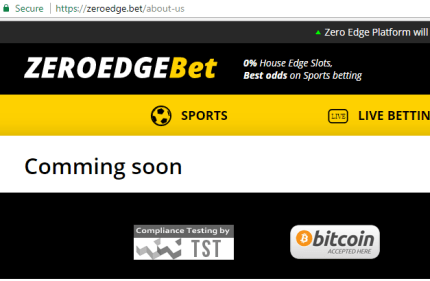
An image from the ZeroEdge cryptocurrency casino. Founder Richard Kim departed after admitting to stealing investor capital and using it on bad bitcoin trades. (Image: Medium)

Kim resigned from the startup gaming entity earlier this month. In an extensive Substack post, he admitted to misdeeds and acknowledged a “20-year struggle with gambling.” He said a phishing site that cost $80,000 “triggered old demons,” compelling the use of cash from a recent fundraising round on leveraged bitcoin trades that went bad.

I resigned immediately after the losses were crystallized, disclosing what happened to my partner and investors. I kept detailed records — this wasn’t about mixing personal and business funds,” wrote Kim. “My failure was in not speaking up sooner, paralyzed by fear and the desperate need to preserve my reputation.”

Kim’s bitcoin trades were made in June — a month which the largest cryptocurrency shed roughly $5,000. Leverage trades would have incurred steeper losses because such positions carry higher risk/reward profiles.

Kim Pledges to Move Forward

Kim acknowledged that he “really messed up,” but he’s also promising to move forward, telling investors they could benefit from their faith in him.

“To my investors: you didn’t just back a project; you invested in my vision, my potential. I will continue building because the world desperately needs what we started,” he wrote. “It is the precisely fact that I have proven untrustworthy that compels me to create trustless systems. Those who stick with me will be my lifetime beneficiaries.”

One of the investors whose capital Kim pilfered was Galaxy Digital — a crypto banking entity controlled by Mike Novogratz. The firm told crypto media outlets the sum it lost in the Zero Edge fraud was nominal.

In a somewhat defiant tone, Kim wax victim, framing his departure from ZeroEdge as an example of “institution vs. individual, trust vs. trustlessness, company vs. community, computer vs. casino.” He added that investors weren’t just supporting ZeroEdge, they were backing Kim as a person and his potential and vision.

What Future Holds for ZeroEdge

Following Kim’s departure, it’s not yet clear what the future holds for ZeroEdge, but it the cryptocurrency casino was attempting to employ a unique concept.

“ZeroEdge.Bet is a unique blockchain based online gambling platform with 0% house edge casino games, commission-free sports betting exchange and an open-source platform for parties wishing to build and operate their own games,” according to the company’s LinkedIn profile.

Crypto casinos have boomed in popularity in recent years, providing an avenue for increased adoption and use of bitcoin and other digital currencies. With ZeroEdge, the premise would be that bettors would place wagers with the Zerocoin token, thus positioning them to profit from the coin’s potential upside, which would be driven by more players embracing the 0% house edge model.

The post Crypto Casino Founder Kim Admits to Losing Investor Cash on Sour Bitcoin Bets appeared first on Casino.org.