Florida Gaming Regulators Afforded Personal Confidentiality With DeSantis Signature

The Florida Gaming Control Commission (FGCC) members have been provided with personal confidentiality protections through a bill signed into law by Gov. Ron DeSantis (R).
Florida Gaming Control Commission Ron DeSantis
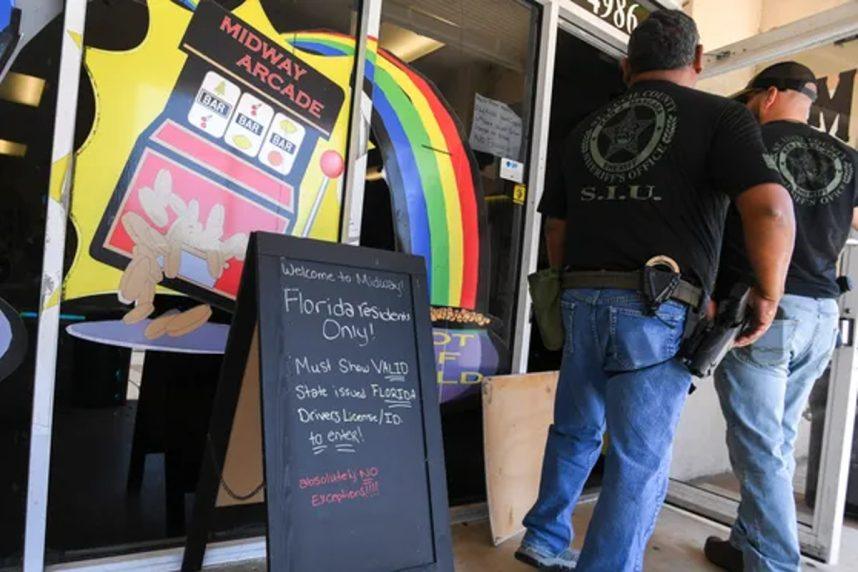
Law enforcement members with the Florida Gaming Control Commission raid an arcade on May 9, 2023, in Fort Pierce. Florida Gov. Ron DeSantis has signed a bill into law that provides gaming commissioners with protections from public records. (Image: Treasure Coast Palm Beach Post)

Senate Bill 692 was introduced in January by state Sen. Travis Hutson (R-Flagler). The measure seeks to provide exemptions from public records for current and former FGCC commissioners and their spouses and children.

The statute passed the Senate in February and the House in March, both by unanimous votes. DeSantis signed the act into law on June 21.

State gaming regulators and their immediate families can now keep confidential their home addresses, personal telephone numbers, dates of birth, their spouse’s places of employment, schools attended, and other personal information. SB 692 brought the FGCC into Florida’s longstanding public records act that provides exemptions for most elected and government-appointed officials.

The Legislature finds that the release of such personal identifying and location information might place the commission’s current or former commissioners and their family members in danger of physical and emotional harm from disgruntled individuals whose businesses or professional practices have come under the scrutiny of the commission,” the state’s lawmaking body wrote in its explanation of the bill sent to DeSantis.

The governor had no comment on signing the bill.

The FGCC has recently cracked down on arcades where law enforcement says illegal gambling machines are operating. The confidentiality statute could help protect commissioners from backlash from those business owners.

Gaming Regulatory Expanding

Florida’s gaming industry is amid considerable change after the U.S. Supreme Court last week denied an appeal challenging the state’s deal with the Seminole Tribe to allow the Hard Rock owner to operate online sports betting in the Sunshine State. Lower federal courts ruled that the U.S. Department of the Interior’s Bureau of Indian Affairs did not error in approving the Class III gaming compact that DeSantis and the tribe reached in 2021.

The amended compact that provides the Seminoles with the exclusive rights to slot machines outside of Miami-Dade and Broward counties and most house-banked table games statewide gives the tribe its first online gaming privileges. Opponents, including West Flagler Associates, which owns and operates the Bonita Springs Poker Room, argued the compact violated the federal Indian Gaming Regulatory Act (IGRA), which mandates that tribal gaming occurs only on tribal lands.

Federal courts opined that since the Hard Rock Bet online sportsbook computer servers remain on Seminole sovereign territory, and Florida lawmakers earlier passed legislation to redefine tribal gaming to permit the transmission of bets via the internet, the compact remains in IGRA compliance.

Gaming Oversight 

The Florida Gaming Control Commission has regulatory jurisdiction over most gaming in the Sunshine State except the Florida Lottery. The commission governs parimutuel wagering, slot casinos in Miami-Dade and Broward, and manages the Seminole Compact.

The lone form of gambling, along with the lottery, that doesn’t fall under the FGCC’s scope are the two gaming properties run by the Miccosukee Tribe. The tribal nation has not entered into a state gaming compact in favor of operating Class I and II gaming, which allows for electronic bingo-based slot-like devices at its Miccosukee Casino & Resort in Miami and gaming plaza along Alligator Alley.

The post Florida Gaming Regulators Afforded Personal Confidentiality With DeSantis Signature appeared first on Casino.org.

Seminole Tribe, DeSantis Win Florida Sports Bet Ruling

seminole_tribe_desantis_win_florida_sports_bet_rulingAn error by a federal judge soon after sportsbooks launched in Florida lawmakers on the budget committee along with recipients of state funding as well as Gov. Ron DeSantis have scored a rather large victory in court – worth at least $2.5 billion and as much as $6b by some estimates.


A three-judge panel on the D.C. Circuit Court of Appeals has rejected a challenge to the 2021 state/tribal gaming compact in Florida that authorized the Seminole Tribe there to offer mobile sports betting. The practice was banned soon after books opened for business in 2021 and online sports betting in the state has been deemed in violation of the law since that time.

Sports Betting Could Open Back Up in Florida Right Away

However, that could change at any time with the new ruling. Sportsbetting could return to Florida virtually overnight.

In a nutshell, the judges decided that any conflict with the opposing party needed to be settled under state law as none of the assertions made actually had anything to do with federal law. So, while it may appear to be a landmark decision, it was really more of a venue correction than anything else in the final analysis and an appeal by the plaintiffs could send the industry right back into a death spiral at any time with a challenge to the decision and an injunction.

The Seminole Tribe applauded the decision but stopped short of saying it would resume sports betting right away.

A lawyer representing the casinos that had challenged the compact pointed out what the plaintiff side saw as nonsensical – according to Hamish Hume, the court had somehow “recognized” that federal gambling laws “cannot authorize gambling off of Indian lands, but then upheld a compact that purports on its face to do exactly that.”

The legal counsel stated, “We respectfully disagree with that decision, and are evaluating our possible next steps.”

The federal appeals court’s reversal of a lower court judge’s order was personally and politically important for Florida Governor Ron DeSantis because he personally lobbied lawmakers to pass the compact in 2021.

A spokesman for the governor stated: “While we are not surprised the lower court’s perplexing ruling was unanimously overturned, this is great news for Florida,” Mahon said in an email to Politico. “We will continue working with the Seminole Tribe of Florida to ensure the success of this historic compact — the largest gaming compact in US history.”

A spokesman for the Seminole Tribe said of the most recent decision: “The Seminole Tribe of Florida is pleased with today’s unanimous decision. It is a positive outcome for the Seminole Tribe and the people of Florida and for all of Indian Country. The Tribe is fully reviewing the decision to determine its next steps.”

New Compact Also Authorizes Table Games

In addition to authorizing sports betting the “new compact” also allowed the tribe to offer table games such as craps and roulette to its existing slots casinos and to build at least one more casino on its reservation the Hollywood area which already has a Hard Rock Hotel & Casino.

In the ruling that blocked implementation of the compact, D.C. District Judge Dabney Friedrich decided the compact was beyond what the laws allowed because it let people place sports bets anywhere in the state – which could be a violation of federal law that govern gambling on Tribal lands.

The impetus of the adverse decision was a pair of lawsuits brought by an anti-gambling group active in Florida, another that focuses primarily on the southern part of the state and casino competitors. Plaintiffs had sued U.S. Secretary of the Interior Deb Haaland, who didn’t block the compact but instead took no action and allowed it to automatically come into effect after some time as prescribed by law.

The erring judge also determined that it would take a new citizens’ initiative to authorize sports betting under the premise that voters passed a law in 2018 that required any expansion of casino gambling without a citizen’s initiative – that law was supported by both Disney Corp and the Tribe.

The Tribe and DeSantis relied on the legal theory that bets processed on servers physically situated on tribal lands were indeed placed “on the Reservation”. The Trump-appointed judge called that a “fiction” and stated that: “When a federal statute authorizes an activity only at specific locations, parties may not evade that limitation by ‘deeming’ their activity to occur where it, as a factual matter, does not.”

The panel of D.C. appeals court judges in essence said that neither argument mattered in this instance: “Whether it is otherwise lawful for a patron to place bets from non-tribal land within Florida may be a question for that State’s courts, but it is not the subject of this litigation and not for us to decide.”

We hold only that the Secretary’s decision not to act on the Compact was consistent with <federal law>,” wrote Wilkins who added, “We express no opinion as to whether the Florida statute ratifying the compact is constitutional” under Florida law.

The balance of arguments raised by the litigants against the legality of the compact was also summarily dismissed as a ‘matter for state courts to decide’.

Source: DeSantis scores big legal win upholding $2.5B gambling deal with Florida tribe, Politico, June 30, 2023

The post Seminole Tribe, DeSantis Win Florida Sports Bet Ruling appeared first on Casino News Daily.