Missouri Slot-Like Gaming Devices Lead to More Litigation

Lawsuits are piling up against Missouri video gaming machine company Torch Electronics. The newest one is from TNT Amusements which claims the slot machine-like devices are illegal and hurt its bottom line.

An example of a no-chance gaming device
An example of a no-chance gaming device, pictured above. Such devices are leading to litigation in Missouri. (Image: Missouri Independent)

TNT alleges Torch violates state consumer law and federal criminal statutes, according to the St. Louis Post-Dispatch. TNT also claims Torch is taking part in fraud.

Torch does not have a Missouri gaming license and does not operate its amusement devices in a casino,” the lawsuit stated, according to the news report.

“Businesses have limited floor space and every spot taken up by an illegal Torch device is a spot taken away from a legal amusement device such as those offered by TNT.”

The 56-page litigation was filed last week in Missouri’s Eastern District court. It seeks treble damages.

TNT provides amusement games and is owned by Jim Turntine.

The same company previously filed a lawsuit against Torch in 2019. Back then, TNT attempted to get Torch to remove its gaming machines at a truck stop. So far, that litigation was unsuccessful.

Class Action Lawsuit

Earlier this month, another lawsuit was filed in federal court against Torch for players who lost money while using the company’s devices. It could become a class action lawsuit and represent many disgruntled players.

It is really so cruel to people who have gambling problems to place them in these situations,” Joe Jacobson, the attorney who filed the litigation, told the Missouri Independent newspaper.

“It is like being a cocaine addict and everywhere you go, there are lines of coke sitting on bar tops.”

Torch gaming devices are found in many convenience stores and truck stops in the state. Torch terminals resemble slot machines. A player puts in money, selects a game to play, and then selects a wager, the Post-Dispatch explained in a report. Winners get paid by a cashier at the business where terminals are located.

Missouri is now debating the legalization of sports betting. But some in the legislature want to see a video gambling bill enacted that would clearly regulate the devices provided by Torch. State officials have left it up to local prosecutors whether to litigate the use of the Torch machines.

So far, there was only one successful Missouri prosecution of the Torch devices. It took place in Platte County. Those gaming machines were seized and destroyed.

Torch Electronics has responded its devices are legal under state law because players are given the chance to see the outcome of the game before they continue, the Independent reported.

No-Chance Games

Torch further contends its gaming machines are legal because there is no “element of chance,” according to the Post-Dispatch.

Company officials further say their machines “fall outside the definition of a ‘gambling device’ under Missouri law,” the Post-Dispatch reported. They call them “no-chance game machines.”

The post Missouri Slot-Like Gaming Devices Lead to More Litigation appeared first on Casino.org.
Indiana Gaming Commission Raises Concerns Over NeoGames 2020 License Application

The Indiana Gaming Commission (IGC) pulled from its meeting Thursday a decision to act on a vendor’s license application that has been in review for nearly three years. However, that move appears to be the last time the application for NeoGames will get extended.

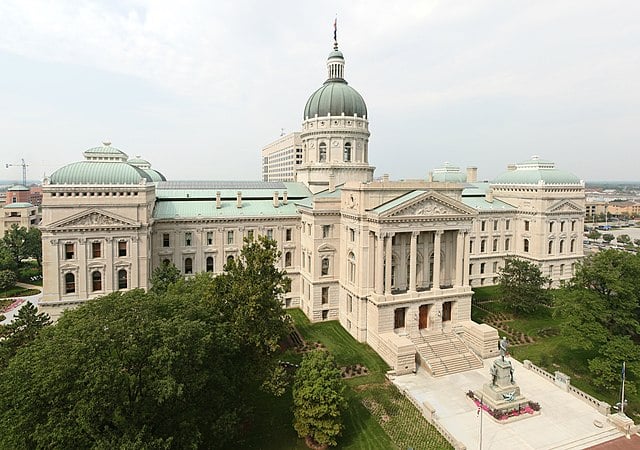
An aerial shot of the Indiana State House in Indianapolis. The Indiana Gaming Commission on Thursday delayed taking action on the license application for NeoGames, a vendor that applied for its license in September 2020. IGC officials said there are concerns about one of the owners of the company. (Image: Massimo Catarinella/Wikimedia Commons)

NeoGames provides player account management (PAM) services in the state for Caesars Sportsbook. It applied for its Indiana license on June 8, 2020, according to IGC records. It received a temporary license three months later and has received two renewals of that temporary license.

IGC Executive Director Greg Small told commissioners that IGC staff has raised issues about its suitability for permanent licensure. In particular, the concerns regard a “substantial owner” of the company headquartered in Tel Aviv.

“Staff and applicant have been working to resolve these concerns, but I regret to inform the commission that we do not have a resolution at this time,” Small said.

The continued delay frustrated IGC Chairman Milton Thompson, who said the review seemed to be taking “abnormally long.” Other commissioners felt the same way.

This looks like a matter that we’ve been kicking the can down the road, or all parties have, and it’s time for everybody to show their hands,” Commissioner Michael Williams said.

Thompson called on the commission staff to provide “a definite plan of action” by the time it comes before the body in June.

Messages sent Thursday to NeoGames and Caesars seeking comment were not returned.

NeoGames Expanding in US

The partnership between NeoGames and Caesars dates back nearly five years. In October 2018, NeoGames reached a deal with William Hill to provide PAM services for the company’s online sportsbooks. Two years later, Caesars Entertainment announced its acquisition of William Hill. Last year, Caesars sold William Hill’s non-US assets to 888 Holdings.

When it purchased William Hill, Caesars acquired a 24.5% ownership share in the iGaming and iLottery services provider. It divested from that position by March 2022.

While NeoGames has not been able to complete its license application in Indiana, it has moved forward to expand its US operations. On Friday, NeoGames announced its iGaming content-providing subsidiary Pariplay agreed to provide games to the DraftKings online casino platform in New Jersey.

“Launching our content with them in New Jersey is a huge statement of intent for us regarding our plans for North America, and we very much look forward to developing this relationship,” NeoGames President Tsachi Maimon said.

NeoGames mentioned Pariplay also expects to provide content for DraftKings iGaming operations in Michigan and West Virginia, with the possibility for additional states pending regulatory approvals.

IGC Fines Ameristar, Horseshoe Casinos

Also at Thursday’s IGC meeting, commissioners approved disciplinary actions against 20 vendors, companies, casinos, and sports betting operators.

The two biggest fines were levied against Ameristar Chicago, which operates a casino in East Chicago. The IGC charged the Penn Entertainment Casino on five counts and fined $37,000. The most serious violation stemmed from a sportsbook supervisor accepting wagers from players via text messages without collecting payment.

Horseshoe Hammond agreed to a $34,000 fine covering five counts against it. The most serious charge was the Caesars casino laying off 16 individuals without first seeking IGC approval. The order stated the casino notified IGC about its intent to lay off workers. Commission staff responded that such a move would only be approved if casino leadership followed the routine procedure.

Last August, Horseshoe reported the positions to be eliminated, including a marketing director and an executive sous chef. However, by the time Horseshoe filed its report with the IGC, those positions were already eliminated and the workers in those roles were let go.

The post Indiana Gaming Commission Raises Concerns Over NeoGames 2020 License Application appeared first on Casino.org.

Titus, Reschenthaler Remain Co-Chairs of Congressional Gaming Caucus

The leaders of the Congressional Gaming Caucus will continue in their roles for the next two years.

Gaming Caucus
US Reps. Guy Reschenthaler (left) and Dina Titus (right) will once again serve as the co-chairs for the Congressional Gaming Caucus in the US House, the lawmakers announced Monday. (Images: Rep. Reschenthaler and Rep. Titus/Twitter)

On Monday, US Reps Dina Titus, D-Nev., and Guy Reschenthaler, R-Pa., announced they would again serve as co-chairs of the bipartisan group that seeks to inform their colleagues in the House about important gaming issues.

Gaming is now widespread across the country thanks to the expansion of legal sports betting. Some form of gaming is now legal in 44 states, and sports betting is now available in 33 states plus the District of Columbia. According to the American Gaming Association (AGA) home to 146 million adults – more than half the adult population in the US.

In addition, 163 of the country’s 435 congressional districts, or 37.5%, have at least one casino.

Leaders Vow to Work Together

Titus’ district includes nearly all of the Las Vegas Strip.

Las Vegas’s gaming industry has set the national gold standard, which has been followed across the country as gaming has expanded,” she said. “As co-chair of the Congressional Gaming Caucus, I look forward to working with Rep. Reschenthaler and our colleagues in a bipartisan way to help well-regulated gaming markets flourish and incentivize economic development in District One and across the country.”

Reschenthaler, whose district covers parts of Southwestern Pennsylvania, noted the gaming industry is coming off a strong year fueled by record-breaking revenue totals.

“I am proud to lead the Congressional Gaming Caucus alongside Rep. Titus to strengthen policies on Capitol Hill to create good-paying jobs, drive economic development, and increase investments in districts across our nation,” he said.

Taxes, Illegal Gambling Key Priorities

Titus and Reschenthaler’s joint release noted three gaming issues the caucus prioritized for the two-year session.

The caucus wants to eliminate what the co-chairs called “discriminatory” taxes, which would include the .25% federal excise tax on legal sports bets that has been around since the 1950s. The tax, along with a $50 per employee fee licensed sportsbooks must pay, is seen as a barrier for legal operators that are trying to win customers from illegal or unlicensed operators.

Another key item for the caucus will be raising the slot tax threshold. It’s been 46 years since the threshold was last raised, and caucus members have previously pushed for the current $1,200 limit to be increased to $5,000.

Caucus members and the AGA have said that the low threshold has led to a sharp uptick in reportable jackpots. That increase has led to more work for casinos, which must shut down the winning slot machine each time as a casino employee prepares a tax form for the winning bettor.

And the caucus also wants to see the federal government do more to end illegal gaming operations that cost states billions in tax revenues.

“The AGA and our members look forward to working with the caucus and new Congress to ensure sensible tax policy and combat predatory, illegal gambling,” AGA President and CEO Bill Miller said in a statement. “These issues are critical to a thriving industry and when gaming thrives, so do communities in 44 states across the country.”

The post Titus, Reschenthaler Remain Co-Chairs of Congressional Gaming Caucus appeared first on Casino.org.

IGA and CNIGA Tribal Gaming Seminar HIghlights from ICE London

iga_and_cniga_tribal_gaming_seminar_hIghlights_from_ice_londonThe Indian Gaming Association and Pechanga.net of America presented a Tribal Gaming Seminar at ICE in London last week. One of the presentations to attendees focused on learning lessons from recent attempts, failures, and successful launches of online casino gaming and sports betting in the U.S.


This was done in light of what legacy gaming providers such as tribal operators are willing to participate in as far as regulatory models and to demonstrate the evolving attitudes of tribal operators looking for a win-win situation with other stakeholders.

The seminar outline suggests that new operators need to secure the cooperation of current stakeholders in the gambling industry before launching products in those states, some of them large and potentially very lucrative, like California where the Pechanga Band of Indians operates Pechanga Resort Casino near Temecula, California. The casino is one of the largest resort casinos in America with over 5,400 slot machines and about 200,000 sq ft of gaming space.

Tribal and Commercial Propositioned Both Failed in November

Two separate ballot propositions for sports betting failed to pass in California during the last regular election when residents were asked whether or not they wanted online betting – a positive result could have eventually led to online casino regulation as well. One of the propositions was backed by commercial operators and the other one was primarily backed by the state’s tribes.

Commercial global brands were unable to push their referendums across the finish line, largely due to a lack of understanding about the tribes’ unique positions in the markets as well as the political clout they heft, along with the revenue goals the legacy operators seek for their constituents – the tribal members.

The synopsis stated that the tribes are not opposed to innovation, modernization, and expansion into new verticals and channels as long as it doesn’t threaten their future participation and involvement in them.

According to an in-depth report on CDC Gaming Reports, when asked how he expects online gaming to change over the next two years, Mark Macarro, Pechanga Band of Indians Chairman, told listeners at the seminar that iGaming is inevitable in the state of California and that Millennials are driving the new gaming channels.

I think there’s a demographic proclivity to want to play online. It doesn’t exist right now with the Baby Boomers and Gen X. But Millennials are different players and we’re not sure that slot machines will be what they want to play”, he said.

Not in my Backyard Unless I Play Too

Macarro was joined on the panel by California Nations Indian Gaming Association (CNIGA) chairman James Siva. The CNIGA chairman was also of the opinion that the commercial betting bill was rejected because voters expected the commercial interests to cooperate with tribal gaming interests in the state.

Siva enumerated the number of tribal gaming interests in the US at 270 and noted that 70 of those tribes’ locations are within the state’s borders.

Tribal gaming represents about a quarter of all gaming revenue in the US and 44% of that occurs in California, according to Siva.

So you break that down and that means that California tribes represent nearly a tenth of the entire gaming market of the U.S. Commercial, tribal, everything”.

He noted that perhaps cooperation or diplomacy may have been a more successful tactic than steamrolling, per see.

Either they massively underestimated the size and reach of those tribes, both politically and financially, or they maybe had bad campaign consultants”, he said.

Panelists Agree Tribal/Commercial Partnerships may be way Forward.

I think there’s still a path for tribes and the commercial operators to work together, but it’s going to be a path and relationship that’s decided by the tribes. This isn’t the first time we’ve had commercial entities want a seat at the table as equal to tribes”, Siva said.

This need for commercial entities to respect the sovereignty of the California tribes and negotiate with them for access to California, as they would with legislators and regulators in other states, was reiterated by Macarro, who promised that the tribes would always counter non-diplomatic attempts to launch in the state

Among the things we learned is that if you have two similar-sounding measures in front of the voters on the same ballot, they will get confused and vote no”, he said.

So if nothing else changes from the corporates, if they make another run at this without doing a lot of the stuff we talked about as being necessary to be successful, it’ll be regarded as hostile by the tribes. And all we would have to do is put another ballot on the initiative. Confuse the voters, they’ll vote no, and both will go down in flames again”, he said.

Source: ICE London: Tribes tout igaming as ‘inevitable’ future of gambling in California, CDC Gaming Reports, February 8, 2023

The post IGA and CNIGA Tribal Gaming Seminar HIghlights from ICE London appeared first on Casino News Daily.

Video Poker Machines Explained

A video poker machine is a great relief for people who want to play poker but don’t have someone to play it with. The game is different from actual poker not only because it’s virtual, but also because it is somehow a simplified version of the actual poker. Video poker and real poker observe the […]