Point Shaving Scandals at Arizona State, Boston College, Northwestern, Tulane

Between 1978 and 1995, basketball players from Boston College, Arizona State, Tulane, and Northwestern were implicated in point shaving and sports betting scandals.
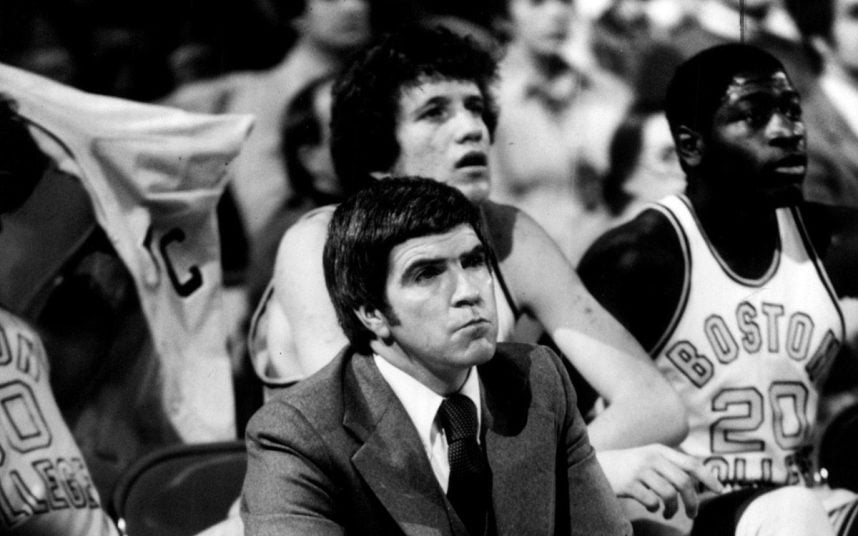
Boston College
Boston College head coach Tom Davis on the bench in 1979 during a rocky season when players were involved in a point-shaving scandal. (Image: Getty)

In the late 1970s, several basketball players from Boston College were directly involved with notorious crime figures from New York City who were made famous by Martin Scorsese’s film “Goodfellas.”

Tulane shut down its basketball program in the mid-1980s after players were caught rigging games. In the 1990s, basketball players from Arizona State and Northwestern were caught up in different point-shaving scandals.

Each of these incidents occurred a full generation after multiple New York City schools were embroiled in their own point-shaving scandals at City College of New York (CCNY) in the early 1950s, and at NYU in the early 1960s.

In the last couple of weeks, Alabama fired its head baseball coach after he got involved in a betting scandal. The NCAA also launched an investigation into student athletes from Iowa and Iowa State, who violated sports betting rules and regulations.

Boston College, Henry Hill, and Goodfellas

The Boston College point-shaving scandal became the subject of an ESPN 30 for 30 documentary titled “Playing for the Mob,” which was narrated by actor Ray Liotta.

Rick Kuhn, a former minor league baseball player from Pittsburgh, accepted a basketball scholarship at Boston College after an injury prematurely ended his pursuit of professional baseball.

The Peralta brothers, Tony and Rocco, knew Kuhn from their hometown of Pittsburgh. They ran a sports betting syndicate and persuaded Kuhn to manipulate games during the 1978-79 season for $2,500 per game. The Peralta brothers had a common friend with Henry Hill. If the name sounds familiar, Hill was portrayed by Liotta in the film “Goodfellas.”

The mobsters in “Goodfellas” made an obscure reference to fixing games at Boston College. Hill got his friend Jimmy Burke (portrayed by Robert DeNiro) involved in the scheme to fix games.

Kuhn enticed his best friend, starting guard Jim Sweeney, to help him shave points.

“We won every game we should’ve won,” said Sweeny in the 30 for 30 documentary. “Sure, it should’ve been by a different margin, but we won those games.”

Boston College was a big favorite against Harvard and Fordham, but won close games.

Hill and the Peralta Brothers wanted Boston College to dump a game against Holy Cross, who was a 3-point favorite. Kuhn didn’t want to lose a huge rivalry game, but the mobsters persisted.

“You cannot play basketball with broken bones,” said Hill, who threatened Kuhn.

Holy Cross won by two points but Boston College narrowly beat the spread, much to the dismay of the mobsters.

The players thought they got away with shaving points that season until Hill was arrested for a drug charge. The government persuaded Hill to become an informant against Burke and other mafia figures, and he inadvertently mentioned the Boston College fixing scandal. The FBI launched an investigation, which was made public in 1981.

Kuhn was the only player from Boston College who served prison time. He was sentenced to 10 years in prison on RICO and sports bribery charges.
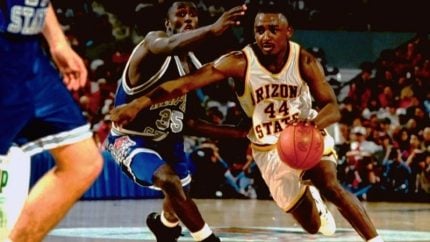
Hedake Smith Arizona State
Hedake Smith from Arizona State drives the lane during a game in 1994. (Image: AP)

Hedake Smith Shaving Points at Arizona State

Arizona State, under head coach Bill Frieder, was one of the better teams in the Pac-10 heading into the 1993-94 season.

Stevin “Hedake” Smith, the leading scorer and point guard for Arizona State, was a losing sports bettor. Smith owed Benny Silman, a campus bookie in Tempe, more than $10K while betting on college football and NFL games.

Joe Gagliano, a bond trader from Chicago, also used Silman as a bookie. Silman tipped off Gagliano about Smith’s gambling debt and mentioned Smith was willing to shave points to pay off his debt.

If your point guard is playing bad, your team is gonna suffer,” said teammate Isaac Burton. “If your point guard is point shaving, your team is definitely gonna suffer.”

Gagliano paid Silman $20K per game to fix two conference games against Oregon and Oregon State. Gagliano flew to Las Vegas with $500K and banked over $2 million betting on both fixed games.

Smith wanted to bet on himself to beat UCLA and asked Gagliano to wager $20K for him. Arizona State was a +4 underdog, but they lost by six points. Smith lost his wager.

To pay off his new debt, Smith agreed to shave points against USC. Although Gagliano won several million of that fixed game, he noticed that his action had significantly moved the line in Las Vegas. He believed the sportsbooks were getting suspicious about his wagers, but at that point, he had profited over $5 million.

A local bookie and drug dealer in Tempe named Big Red discovered Smith’s involvement and threatened to rat him out if he didn’t help shave points against Washington. Smith agreed and called Gagliano to let him know his predicament.

At that point, small-time bettors all over campus found out that the fix was in on the next Arizona State game, so they hopped in their cars and drove to Las Vegas. The line against Washington opened at -12, but quickly moved to -7 when sportsbooks realized the game wasn’t on the level. Gagliano bet $3 million at -7, but the line moved to -3 by the time the game tipped off.

The Nevada Gaming Commission contacted the FBI after they flagged the game. A typical college basketball line changes around 10 times, but the Arizona State vs. Washington line changed 44 times.

Arizona State trailed at halftime and Frieder told his team that the FBI was watching them, so they better play better in the second half. Smith and his teammates were freaked out, so they stopped shaving points. They erased a halftime deficit and won by 18 points.

All of the Arizona State students in Vegas lost their bets and Galiano incurred a $3 million loss on that game.

Smith, Silman, and Gagliano were caught and served time in prison. The Arizona State point-shaving scandal was featured in an episode of the Netflix series “Bad Sport.”


“@context”:”http://schema.org/”,”@id”:”https://www.casino.org/news/scandals-point-shaving-arizona-state-boston-college/#arve-youtube-p__ibomof4o645f0b0319345310882056″,”type”:”VideoObject”,”embedURL”:”https://www.youtube-nocookie.com/embed/P__IbomoF4o?feature=oembed&iv_load_policy=3&modestbranding=1&rel=0&autohide=1&playsinline=0&autoplay=0″

Tulane Frat Boys Fix Games in 1985

A point-shaving scandal rocked New Orleans in 1985 when several basketball players from Tulane were implicated in a scandal that involved both point-shaving and cocaine.

Gary Kranz, a student and campus cocaine dealer, offered senior forward Clyde Eads a payment of cash and drugs to shave points in a game against Southern Miss.

Eads asked several teammates, including center John “Hot Rod” Williams who was an NBA prospect, to help keep the game close. Kranz and his fraternity brothers bet on the fixed game, and participating players were paid between $400 and $900.

Kranz and the frat boys attempted to fix a second game against Virginia Tech, but failed. They focused on fixing a third game against Memphis State, who were 20-2 at the time, and who would eventually advance to the Final Four in the 1985 March Madness tournament.

Tulane was a +7 home dog but led by six points at halftime even though Williams purposely got himself into foul trouble. Memphis State pulled away in the second half and won by 11 points to cover the spread. Five players from Tulane earned $13,500 for fixing that game, and Williams banked $5,000.

Ned Kohnke, a local lawyer and Tulane alum, heard unsettling rumors about the rigged game against Memphis State. He launched his own investigation and discovered that the frat boys did very little to cover their tracks or keep the fix a secret.

Kohnke shared his evidence with New Orleans district attorney, Harry Connick, Sr., who launched a full investigation. If that name sounds familiar, it’s because he’s the father of musician Harry Connick, Jr.

Tulane shuttered its men’s basketball program in 1985 in the wake of the scandal. The program was reinstated at the start of the 1989-90 season.

Williams was selected by the Cleveland Cavaliers in the second round of the 1985 NBA Draft. In 1986, a jury found Williams innocent in connection with a sports bribery scheme.

Point Shaving at Northwestern

Northwestern is a prestigious academic institution in the Chicago suburbs, but they’re not known for their athletic excellence compared to other sports-crazed schools in the Big Ten. Northwestern basketball teams, in particular, are usually among the worst teams in the Big Ten. They posted just two winning seasons between 1970 and 1994.

Northwestern went 5-22 in 1994-95, so it’s surprising that players on a last-place team were involved in a point-shaving scandal.

In 1994, Northwestern suspended two student athletes for gambling on football games that didn’t involve Northwestern. Dennis Lundy, the star running back from the football team, and Dion Lee from the basketball team were busted by school officials.

Lee, a senior guard and starter, was suspended for six games at the start of the 1994-95 season. Upon his return to the team, he was approached by a local bettor to fix three conference games.

Kevin Pendergast, who played football for Notre Dame, wanted Lee to shave points against Wisconsin, Penn State, and Michigan.

Lee sought out another starter to help him fix the games. He persuaded senior forward Dewey Williams to assist him. They had a combined scoring average of 20.1 points per game, but each averaged 6.3 points per game in the three fixed games.

Pendergast offered Lee $4,000 to fix the Penn State game. Penn State was a -14 favorite and they defeated Northwestern by 20 points. Lee tallied just two points against Penn State.

Both Lee and Williams were indicted on federal charges for fixing those three games.

The post Point Shaving Scandals at Arizona State, Boston College, Northwestern, Tulane appeared first on Casino.org.

Regulators in Seven US States Ask US DOJ to Act Against Offshore Operators

regulators_in_seven_us_states-As_us_doj_to_act_against_offshore_operatorsThe following article reflects the knowledge, experience, and well-reasoned opinions of the authors and is not meant to be construed in any way as legal advice. Online gamblers in all US states should consult their state laws or seek legal counsel to determine if online gambling at unlicensed offshore websites or gambling venues licensed by regulators located anywhere but within their domiciled states is a crime or a right to be exercised freely by responsible adults. The same applies to federal gambling laws or any other ancillary issue related to online gambling.

Regulators from seven US states have contacted the United States Department of Justice in an attempt to nudge the DOJ into “doing something” about offshore competition in the online gambling market.

Not Understanding Federal Law?

As is usually the case when such actions occur, the signatories refer to all offshore gambling sites with a broad brush whether purposefully or not – lumping all other operators of gambling into one basket and broadly referring to them as “illegal online gambling sites.

At least that is the implication as state regulators and spokespeople from the American Gaming Association (AGA) consistently leave out any real differentiation among casino sites licensed offshore, illegal sportsbetting sites, and the very small handful of operators that provide services to players in the USA with no known license at all.

Painting every online gambling operator with the same broad brush appears to the informed consumer or observer as disingenuous at best.

The most recent public relations gambit is co-signed by regulators in some of the most financially successful US gambling states including Colorado, Illinois, Louisiana, Michigan, Mississippi, Nevada, and New Jersey.

Some of the issues addressed in the letter to US Attorney General Merrick Garland are some real and unreal dangers the ill-informed assume are associated with gambling online. These include age verification, money laundering concerns, responsible gambling protocol, game fairness, and the lack of each or any state capturing tax revenues.

The letter also states that offshore operators are not subject to any licensing requirements. The vast majority of those points are incorrect and are most likely based on good-faith misunderstandings of how offshore online gambling operators actually operate.

Well over 90% of offshore casinos and most sportsbooks that serve US players are licensed in the jurisdiction of Curacao (formerly known as the Netherland Antilles). Operators are required to verify the identity, age, ownership of financial instruments used to deposit, a player’s address, their subscription to local utilities, and quite often a copy of their bank account statements at a minimum.

Three Decades of Compliance

Operators in the offshore jurisdiction of Curacao have followed essentially the same protocol since the mid-1990s.

These documents cover nearly all of the concerns raised by the regulators including money-laundering concerns.

The over-arching government-sanctioned gambling license issuer makes sure that anti-money laundering concerns are taken care of through international authorities in compliance with an anti-money laundering/counter financing of terrorism (AML/CFT) framework that addresses both risk issues.

In a nutshell, what’s known as “document verification” – which is enforced by 99% of all offshore operators as any offshore player knows – addresses all concerns listed except responsible gambling issues and tax collections.

Responsible gambling is only addressed at the most critical level which is gambler self-exclusion. Even there, if an operator refuses to let a gambler self-exclude, they will have their Curacao license revoked. However, there are no auxiliary tools available for players to set deposit or time limits, force breaks at prescribed time intervals, or any of the other things more stringent regulatory regimes such as the Malta Gaming Authority or the British Gambling Commission may require.

That leaves the competition for the gambling dollar and state tax revenues buried in slurs of illegality, and black market accusations.

While this may seem to be counter-intuitive, offshore casinos are actually not illegal at the federal level nor have they ever been in the United States. It is, however, incumbent upon each consumer to check their own state laws to determine if the practice might be legal in their state. If competent legal counsel is indicated, that should be sought.

The Wire Act of 1961

Interstate or Inter-territorial sports betting is illegal in the United States and has been since 1961. While the US DOJ under various administrations has sided with casino moguls such as the late Sheldon Adelson in determining offshore casino gambling to be illegal, the world’s biggest lottery company by gross receipt,s, IGT recently sought and received a declaratory judgment (once and for all) that very specifically informs that The Wire Act only applies to sports betting operations. The act of casino gambling has no federal law to prohibit it.

The sticky wicket in this reality is the UIGEA (Unlawful Internet Gambling Enforcement Act of 2006) which neither creates new gambling laws nor modifies any existing laws as clearly stated in the law itself. It does, however, make most online financial transactions (deposits and withdrawals) illegal and de facto money laundering simply because US financial institutions have been given “guidance” that assumes the Wire Act applies to all interstate or inter-territorial wagers.

However, the very act of providing a gambling service or a US citizen partaking in offshore gambling is not a crime at the federal level by any law this editor has seen in nearly three decades in the industry. so it’s unclear how Attorney General Merrick Garland could be of assistance to state regulators unless he attacks the practice “from the side” and deems them all to be illegal thanks to incorrect guidance from the Federal Trade Commission (FTC) and the Federal Deposit Insurance Corporation (FDIC) which was issued during the Bush administration in 2007 under the false premise that the Wire Act actually applied to anything but sportsbetting.

In the letter to AG Garland, the Executive Director of the Michigan Gaming Control Board (MGCB), Henry Williams states: “In Michigan, strict laws and rules govern internet gaming and sports betting and provide consumer protections, promote confidence and ensure fair and honest gaming. We are willing to help the US Department of Justice in any way we can as it pursues enforcement of US laws against offshore illegal gaming enterprises that take advantage of our citizens.

State regulators like the MGCB ensure operators offer products that pass technical standards and testing, and we also require operators to comply with reporting requirements.

“Offshore operators flaunt state regulations and offer products that do not protect the public, which greatly concerns me and my fellow state regulators,” Williams added.

He continued, “Regulated operators recognize licensing is a privilege that can be taken away, but illegal operators do not face similar consequences for failure to follow laws and maintain integrity.”

Source: Regulators urge DoJ to take action on offshore gambling, iGaming Business, May 5, 2023

The post Regulators in Seven US States Ask US DOJ to Act Against Offshore Operators appeared first on Casino News Daily.

Endorphina is on the front lines with AI-assisted image generation for online slot machines

endorphina_is_on_the_front_lines_with_aI_assisted_image_generation_for_online_slot_machinesEndorphina is one of the first better-known slot studios to enter the fray at the front lines of AI-assisted image generation for online slot machines. Joker Ra was released on April 27, 2023. The company stakes a claim to the first-ever online video slot release wherein every design element was created with the help of artificial intelligence.
The press on the game doesn’t go into any great detail about what that means nor how much coaxing, coaching, prompting, or other ‘training’ went into the design in order to create harmonious effects between all of the iconography and to tie the theme together – it was most likely intensive and extensive.

How Was Ra Chosen as the Mascot?

Ra was the father of creation according to ancient Egyptian mythology and the king of all other deities. His symbology belies his patron hood of the sun, heaven, kingship, power, and light.

Endorphina has pulled that all off with a deft hand, however, there is – and perhaps intentionally – a tinge of hauntedness to the game, a creepiness like many early AI images portrayed. That’s not to say the artwork is any less than excellent, it’s just a little creepy when you mix a Joker with the king of creation – you are sure to end up with something inherently disturbing. The Joker can signify all of the beginnings and endings in life’s journey so they also fit together in a sort of perverse way.

As with many of Endorphina’s works, this one lacks a comprehensive rule set in the pay table. There are two scatter symbols and you’ll have to use your imagination or simply jump into gameplay and wait awhile to figure out which does what and why. None of it is explained in the directions or pin the paytable but we do learn that one of the scatters only appears on certain reels. We also learn that wild Jokers appear on the three central reels and expand vertically to complete all winning combinations.

The Pyramid of the Sun scatter, which appears on all reels is simply rendered but well executed and the Pharaoh’s Chest scatter (reels 1, 3, and 5) is an ornate scarab-wing adorned box that cries out to be larger in size so we can examine the details more closely.

Expanding Wilds on Three Middle Reels

The expanding Ra wild symbols on reels 2, 3, and 4 have plenty of opportunities to spread out vertically on this 5 reel, 4 position slot with 100 fixed paylines – so expect his disturbing little chortle quite often prior to the sound effects of the standard symbols whose win lines he helps to connect.

Much as NetGaming chose to keep the underlying slot game maths and mechanics simple when it released its first AI-assisted imagery game on April 13, Wild Buffalo Bonanza – so has Endorphina with the release of Joker Ra.

From a purely visual perspective, one would almost have to be more a fan of Egyptian slots than great American Bison games to prefer this title over the other – unless a more regimented and segmented art style is more to your liking. Buffalo is quintessentially NetGaming and nearly unmistakable as a hybrid creation that shows an almost atmospheric collaboration between man and machine. Joker Ra has uniquely defined elements that fit well into a visual narrative yet remain somewhat distinct while not disjointed. BGaming’s Alien Fruits is, well, as the name implies simply kind of goofy looking but not in any way that would reveal to a casual observer anything about its creationary origins.

According to the company: “The AI’s algorithms and machine learning capabilities allow for intricate and visually impressive designs that blend Ancient Egypt’s essence with a modern twist.”

Source: Designed by AI, a Game by Endorphina, Endorphina News, April 27, 2023

The post Endorphina is on the front lines with AI-assisted image generation for online slot machines appeared first on Casino News Daily.

Rivers Casino Portsmouth Pays $275K Fine for Regulatory Infractions

Rivers Casino Portsmouth in January made history by becoming the first permanent casino to open in Virginia. But as a result of securing its place in Virginia’s rich history, the property also now has the dubious distinction of being the first casino to be fined by the Virginia Lottery Board.

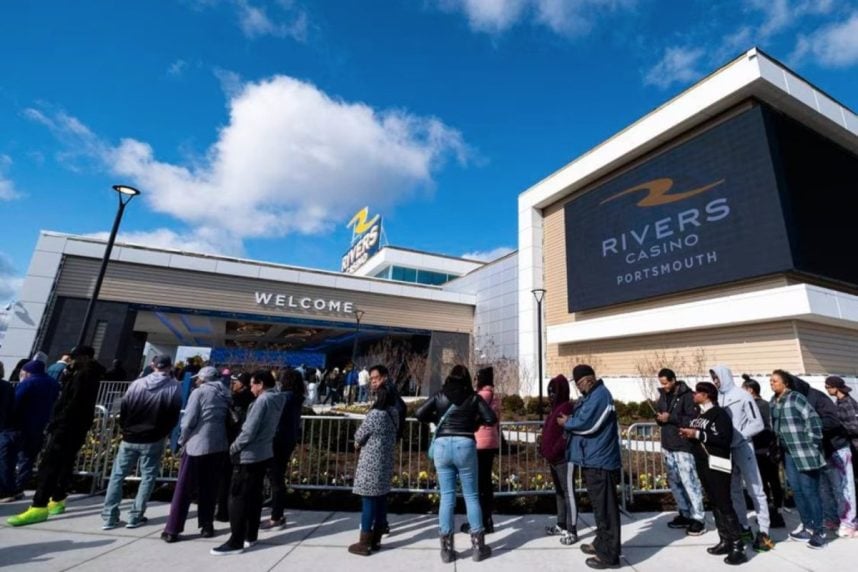
Rivers Casino Portsmouth Virginia gambling
Patrons stand in a line outside Rivers Casino Portsmouth ahead of its grand opening on Jan. 23, 2023. The Virginia casino has agreed to pay the state $275K for three allegations of compliance breaches. (Image: The Virginian-Pilot)

Virginia’s 2020 commercial gaming bill directed all regulatory responsibilities for the state’s liberalization of brick-and-mortar casinos to fall under the scope of the Virginia Lottery Board. The agency handles all licensing matters and assures compliance of gaming operations.

Board officials said alleged violations at Rivers Portsmouth were brought to the state’s attention in January and February. Based on the review, the Lottery Board informed Rivers Casino that there was evidence suggesting that the casino, directly and through its contractors and agents, had allegedly violated provisions of the state’s Casino Gaming Law and the agency’s regulations. The mishaps reportedly occurred both before and after the casino’s opening on Jan. 23, 2023.

Rivers Casino Portsmouth, owned and operated by Chicago-based Rush Street Gaming, sought to remedy the allegations through a $275K settlement instead of a more costly administrative hearing.

Settlement Reached

The Virginia Lottery Board alleged Rivers’s violations included allowing underage people access to the casino floor. The claims also suggested that Rivers failed to properly license certain slot machines, and allowed a self-excluded person entry who had registered with the Lottery Board’s Voluntary Exclusion Program.

The Lottery has asserted that these actions violated the Casino Gaming Law and the regulations promulgated thereunder, and that these actions were sanctionable,” the Virginia Lottery Board’s settlement agreement with Rivers explained. “Rivers has cooperated fully with the Lottery’s inquiry into these matters, and has taken corrective measures, and has developed a corrective action plan to ensure future compliance with the Casino Gaming Law and its related regulations.”

Casinos often self-report regulatory infractions to their state gaming regulators. Self-reporting is typically a stipulation of holding a gaming license.

During the Virginia Lottery Board’s meeting on the Rivers allegations last month, a discussion ensued about how the board became aware of the violations. Board Executive Director Kelly Gee said those details “cannot be discussed in open session.”

Matter Resolved

The Virginia Lottery Board said the review of Rivers Casino Portsmouth has been deemed settled. But if the casino encounters additional regulatory infractions in the immediate future, the settlement could be readdressed.

For now, the $275K payment resolves the alleged violations. The Lottery Board said the settlement “does not constitute an allegation, an admission, or a denial by either party that a violation of law or regulation has occurred.”

Virginia’s Casino Gaming Law explains that allowing persons under 21 years of age to gamble inside a brick-and-mortar casino regulated by the Board is a Class 1 misdemeanor.

Rivers Casino generated gross gaming revenue (GGR) of about $24.7 million in February, its first full month in operation. March GGR was $23.6 million.

On the March haul, Rivers paid about $4.3 million in state and local taxes. About $1.4 million stayed in Portsmouth for the city’s local government.

The post Rivers Casino Portsmouth Pays $275K Fine for Regulatory Infractions appeared first on Casino.org.

Three Online Slots Made with AI Assistance

three_online_slots_made_with_aI_assistanceThe casino industry online and on land has been using artificial intelligence (AI) for quite some time now. However, with the advent of Generative AI across several models, the term with broad meaning can now be used to generate images directly from text prompts.


With competition for your gambling dollar strong, and an ever-increasing number of people around the globe partaking in risk-based entertainment along with a variety of other reasons we’ll look at as this report progresses, it comes as no surprise that AI-generated images have found their way onto slot reels, albeit only on virtual online slot machines at this point.

April 2023 saw the release of at least three online slot titles with imagery created by or with the help of artificial intelligence. The three pioneering companies and titles we’ll cover here are NetGaming (Wild Buffalo Bonanza), Endorphina (Joker Ra), and BGaming (Alien Fruits). And while there could be more (disclosed or undisclosed) we’ll focus on these games as they all came out about the same time and have been heralded in the press – or at least press releases – as innovations and game changers.

Click on the following links to see release notes and details of the following slot titles developed with AI-assisted imaging:

Wild Buffalo Bonanza (released by NetGaming on April 13, 2023, to Whitehat Gaming operators and globally on 4-27) See here.

Joker Ra (released by Endorphina 4-27) See here.

Alien Fruits (released by BGaming on April 13, 2023) See here.

A Little Background on AI in the Gambling Industry

One of the most obvious ways AI has been used in the gambling world is for security Facial recognition coupled with AI has been used to identify card counters, self-excluded gamblers, banned cheats, and organized criminals from land-based operations. On the negative side, it has been used in whale playgrounds like Macau to identify high rollers in order to target them for casino profits through various tradecraft.

On the online end of things, AI can analyze data on player patterns and habits and when an aberration occurs even real-time play can be examined more closely by the machine or by operations management. If it appears the purported gambler is not behaving like the known player, steps can be taken to prevent fraud including theft from the player or casino such as money laundering.

AI is also used more extensively all the time in jurisdictions with robust player protection frameworks to identify problem gamblers and either intervene automatically or by alerting staff who know what to look for, what type of questions to ask, and which actions to take to protect vulnerable persons.

Artificial intelligence has been used by companies big and small in all online markets analyzed. There isn’t much public domain information available but reading between the lines can be productive when the story seems to be the same or similar if what is seen in the gaps is the same across multiple platforms, markets, and jurisdictions.

In a nutshell, the most obvious use of AI in online casinos is in collecting data on players’ behaviors and then shaping the online experience to give gamblers the most satisfying experience possible without affecting the odds or any other element of a fair game.

Understanding what type of slots most appeal to a certain player and then making similar titles with some of the same or similar maths or mechanics will allow the operator to further define what the player is after. Was it simply the buffalo theme or was it the risk and reward factor? Was it the fact there are two bonus rounds or the possibility to buy one of the bonuses?

Just a Few of the Things Affected by AI

These are but a few of the elements that can be sussed out to deliver a better player experience. A better experience means more intense engagement and deeper engagement means longer playtime. Since the House always wins in the end (or at least can maintain an edge until time guarantees it if players don’t quit while they are ahead), the longer a player plays the more they will lose, on average.

The type of bonus you use most often, the sort of wagering requirements you normally accept, whether or not you are more apt to take a once-in-a-lifetime huge cashout type offer or are simply happy to greatly extend playtime and are willing to accept a huge percentage match in exchange for liberal terms and a maximum cap on how much you can win – these can all be handled by AI. In fact, they are and have been for nearly a decade in some instances – but again – it’s not really something that operators or marketers want their competitors to know or even their players – that could take the fun out of it for some.

While many things are accomplished by algorithms or outright AI in the background, none can change the end result of games like slots. Well, sure they could, but not in a way that matters. Regulators such as the BGC, (UKGC) not only require a game to have a stated or “theoretical” RTP (return to player percentage) they also require the actual RTP to fall in line with that given number.

How long (how many iterations or spins) it takes to reach it, how long it stays at that point, and how often and far it deviates over the course of time are simply matters of volatility rather than payback percentages and that is taken into account as well. If it takes a low variance title 400,000 spins for the actual RTP to arrive at the theoretical RTP number – and stays within the standard deviation (say 5 points above, 5 points below, or anywhere in between) for 95 out of 100 simulations (5% confidence interval) then it would appear not to matter to the regulator just how that occurred as long as the maths are solid.

By the same measure, players shouldn’t care how it occurs as long as it occurs – and – each spin has the same chance to produce any given result.

Thankfully, there aren’t any games that mess around with the maths that are written in stone. There was one product on the market several years ago that was really a scratch card but looked like and behaved like a slot machine. The problem with it was that as soon as the “jackpot prize” was awarded – once out of every million interactions – it was no longer available to be won until “all the tickets” were sold – or every spin needed to award each and every prize was executed. The developer responsible for that type of game changed methods prior to being awarded a license in Great Britain.

AI could handle every element of all of the inner workings of a slot game and even come up with new mechanics that nobody has tried so far. It’s entirely possible that there are labs undertaking the challenge right now. However, the first AI-generated slots were strictly garbage – even though high-quality clones could be created today with the tech.

Garbage in – Garbage Out

In 2019, Ars Technica reported on a duo of developers who created a robot to create mobile slot games in 2013. The experiment created over 1,500 junk games with minor variations in theme and changed perhaps one image to match the theme. The games, available on Google Play, are all dead now and the duo credits their junk with helping “train” Google algorithms to recognize and remove certain types of apps.

According to Ars: “In their GDC presentation, <the devs> mostly left the data up for people to peruse in a laughing manner, but also with a human angle about the costs that might arise if you chase such a robo-generated app dream with profit, not laughs, as the goal.”

The direction today’s developers are taking in an increasingly competitive marketplace seems much better – the images are stunning and on point and the game maths and mechanics are still, presumably, human creations. Where AI-assisted game development goes from here is anybody’s guess.

Source: Here’s How Casinos Are Using AI, Medium, May 31, 2021

The post Three Online Slots Made with AI Assistance appeared first on Casino News Daily.